
 Kia Sorento: Air bag warning and indicator. Air bag warning light. Supplemental Restraint System (SRS) components and functions
Air bag warning and indicator. Air bag warning light
Air bag warning light
The dedicated SRS warning light on the Kia Sorento instrument cluster monitors electrical circuits, impact sensors, wiring harnesses, seat belt pretensioners, and rollover modules to alert the driver to potential safety system faults.
If the SRS warning light stays illuminated longer than 6 seconds after pressing the ENGINE START/STOP button to ON, or if it turns on while driving, the system may have logged a fault code. Have the vehicle inspected immediately by an authorized Kia dealer.
Any of the following operational anomalies indicate an SRS malfunction in your Kia Sorento that requires immediate inspection by an authorized Kia dealer:
-
The warning indicator light fails to illuminate during the initial instrument cluster self-test when turning the ENGINE START/STOP button to the ON position.
-
The airbag light remains continuously illuminated after the initial 3-to-6 second ignition check sequence finishes.
-
The warning icon turns on or flashes intermittently while the vehicle is actively in motion.
-
The indicator light blinks rapidly instead of illuminating steadily when switching the ENGINE START/STOP button to the ON position.
Supplemental Restraint System (SRS) components and functions
|
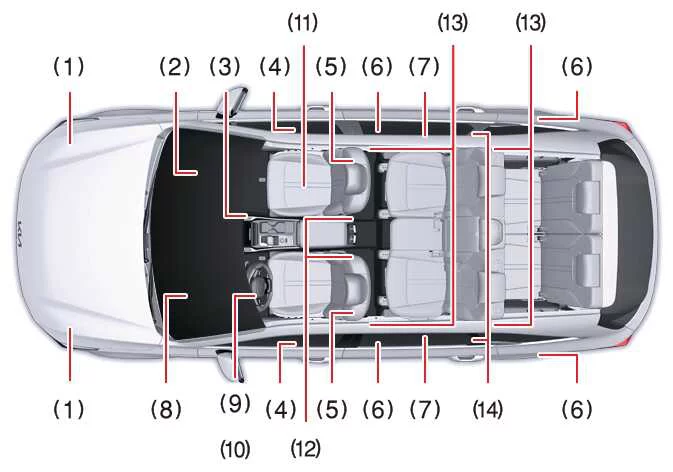
The layout and precise location of the Supplemental Restraint System (SRS) components in your Kia Sorento may vary slightly depending on the trim level and production year. The complete SRS network comprises the following key safety elements:
-
Front impact sensors: Mounted in the front structure to detect forward deceleration forces instantaneously.
-
Passenger’s front airbag module: Housed within the dashboard above the glove box to protect the front passenger during severe frontal impacts.
-
SRS control module (SRSCM) / rollover sensor: The central computer that continuously evaluates crash forces and vehicle tilt angle to trigger deployment when necessary.
-
Side pressure sensors: Located inside the door structures to detect rapid pressure changes caused by lateral impacts.
-
Front side airbag modules: Installed in the outboard sides of the front seatbacks to cushion the torso during side-impact collisions.
-
Side impact sensors: Positioned along the B-pillars and lower body frame to measure lateral acceleration.
-
Curtain airbag modules: Running along both roof rails to provide head protection across multiple seating rows during side impacts or rollovers.
-
Driver’s knee airbag module: Located under the lower steering column to reduce leg and knee joint injury risks.
-
Driver’s front airbag module: Integrated into the central steering wheel pad to cushion the driver's head and chest.
-
Airbag warning light: Positioned on the main instrument cluster to notify the driver of system status or operational faults.
-
Occupant Detection System (ODS): Embedded in the front passenger seat to determine whether the front passenger airbag should be enabled or disengaged.
-
Front seat belt buckle sensors: Monitor buckle latching to help the SRSCM coordinate pretensioner and airbag deployment timing.
-
Retractor pretensioner assemblies: Instantly remove slack from the seat belts upon impact to hold occupants firmly in position.
-
2nd row seat side airbag modules: Installed in the outboard seat structures of the second row for enhanced rear-occupant lateral protection.
The electronic SRSCM continuously monitors every sensor and component in your Kia Sorento while the ENGINE START/STOP button is in the ON position, and it remains active for approximately 3 minutes after ignition shutdown to ensure proper response in severe frontal, off-center, or side collisions.
Upon turning the ENGINE START/STOP button to the ON position, the SRS airbag warning light on the instrument panel illuminates for roughly 3 to 6 seconds for self-diagnosis, after which it should turn off automatically if no faults are detected.
WARNING
If any of the following symptoms occur, your Kia Sorento safety system has detected a potential malfunction. Have the vehicle inspected by an authorized Kia dealer immediately:
The indicator light does not turn on briefly during the initial check when you turn the ignition ON.
The warning light remains continuously illuminated after the initial 6-second diagnostic cycle.
The SRS indicator turns on or stays illuminated while the vehicle is in motion.
The warning light blinks repeatedly when the ENGINE START/STOP button is switched to the ON position.
|
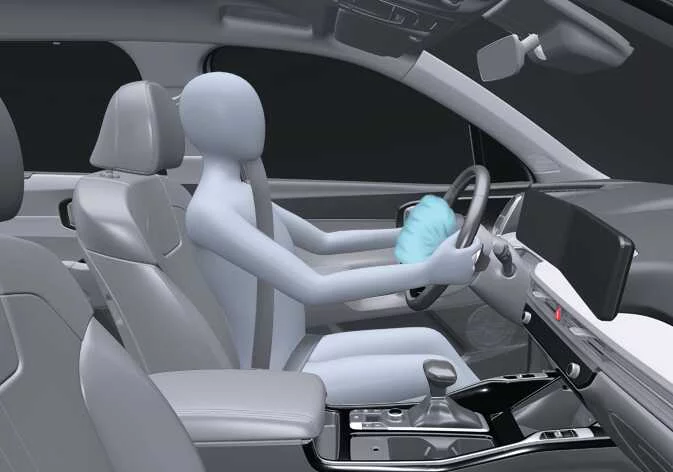
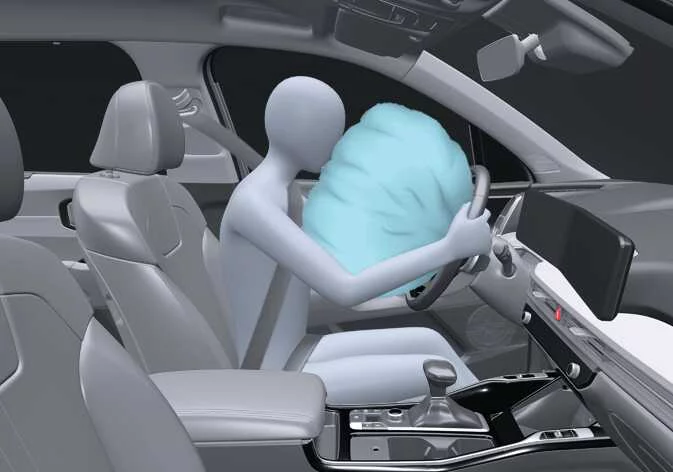
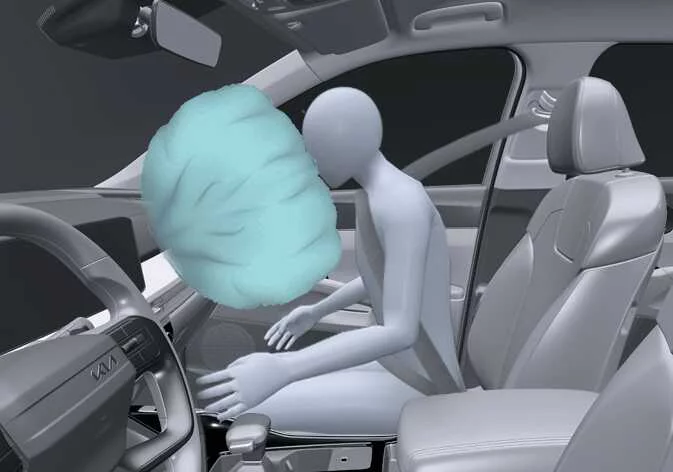
The primary front airbag modules are concealed inside the central steering wheel hub for the driver and within the upper instrument panel above the glove box for the front passenger. When the central SRSCM detects a sufficiently severe frontal impact, it sends an instant electrical signal to trigger deployment.
|
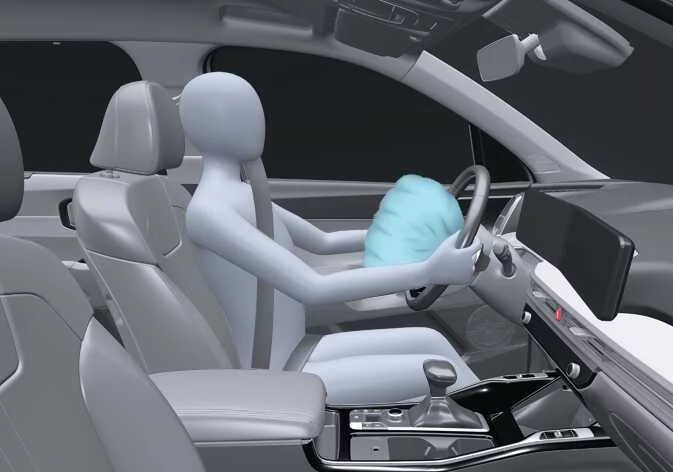
During a collision, gas pressure instantly splits engineered tear seams molded directly into the trim covers of your Kia Sorento, allowing the protective cushion to deploy fully within milliseconds.
|
A fully inflated airbag combined with a properly fastened 3-point seat belt effectively absorbs forward kinetic energy, significantly lowering head and chest trauma risks for driver and passenger alike. Immediately after reaching peak inflation, the fabric rapidly deflates so the driver maintains forward visibility and full physical capability to operate steering and braking controls.
|
 Overview. How does the air bag system operate?
 Occupant Detection System (ODS)
See also:
Input Speed Sensor Description
Input speed sensor (A) is a vital unit that measures the rate of rotation
of the input shaft inside the transaxle and delivers the readings to the Transaxle
Control Module(TCM). The sensor pr ...
Tire replacement
If the tire is worn evenly, a tread wear indicator will appear as a solid band
across the tread. This shows there is less than 1/16 inch (1.6 mm) of tread left
on the tire. Replace the tire when t ...
Driver Attention Warning settings. Leading Vehicle Departure Alert. Driver Attention Warning operation
Driver Attention Warning settings. Leading Vehicle Departure Alert
Leading Vehicle Departure Alert
...
Manuals list
- Kia Sorento MQ4 2021-2026 Owners Manual
- Kia Sorento XM 2011-2015 Owners Manual
- Kia Sorento XM 2011-2015 Service Manual
