
 Kia Sorento: Overview. How does the air bag system operate?
Overview
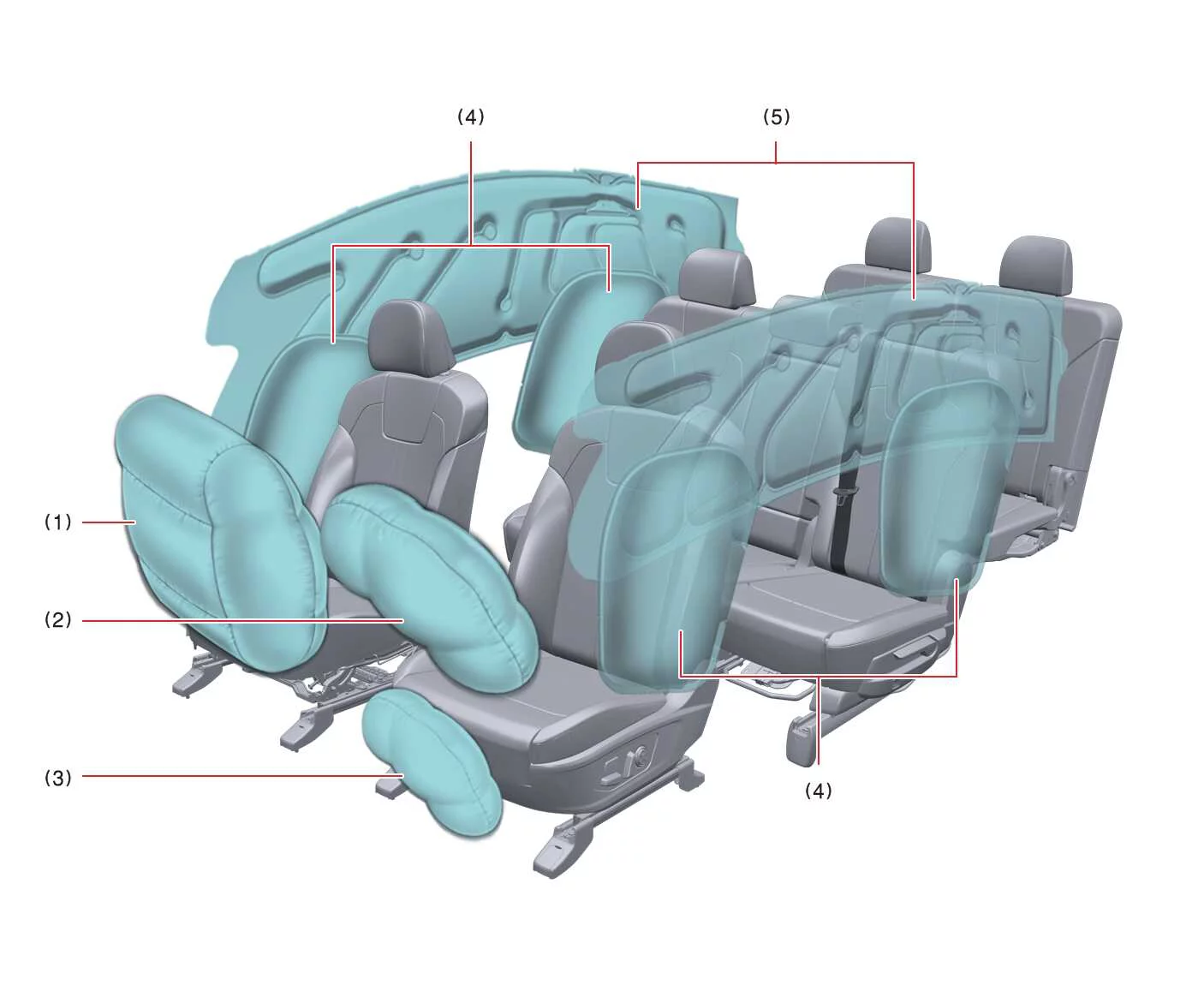
-
Front Passenger Airbag: Deploys from the upper dashboard assembly to protect the front occupant during significant frontal collisions.
-
Driver Front Airbag: Housed within the central steering wheel hub to shield the driver from direct steering column impact.
-
Driver Knee Airbag: Positioned beneath the lower steering column to reduce lower-limb impact energy and severe knee joint injury.
-
Side Thorax Airbags: Integrated into the outboard seatbacks to cushion the torso and pelvis from lateral collision forces.
-
Side Curtain Airbags: Extended along both roof rails above the side windows to deliver head protection across front and rear seating rows.
Even with advanced multi-stage supplemental restraints, the Supplemental Restraint System (SRS) in the Kia Sorento is designed as a secondary safety measure. All occupants must consistently buckle their three-point seat belts to minimize the risk of severe injury or ejection during high-impact collisions and vehicle rollovers.
How does the air bag system operate?
-
Airbag modules remain primed whenever the ENGINE START/STOP button is set to the ON position, maintaining system readiness for approximately 3 minutes even after turning the vehicle ignition OFF.
-
The designated SRS sensors instantly deploy the appropriate airbag modules during severe frontal or lateral impacts to absorb deceleration forces and safeguard cabin occupants.
-
Airbag deployment depends on dynamic factors like crash deceleration, collision angle, and object rigidity rather than vehicle speed alone. Electronic sensors continuously analyze incoming impact data to decide whether pyrotechnic inflation is required.
-
Airbags do not inflate in every collision; deployment depends on vehicle speed, impact angle, structural stiffness of objects hit, and deceleration thresholds calibrated for occupant safety.
-
Front airbags fully expand and vent within milliseconds. The deployment occurs so rapidly that occupants rarely see the airbags inflate, typically observing only the deflated fabric curtains hanging from their storage compartments after the incident.
-
In addition to absorbing severe side-impact energy, the side thorax and curtain airbags deploy automatically if the onboard rollover sensors detect dynamic tilting or loss of vehicle stability in the Kia Sorento.
-
Side curtain airbags remain pressurized longer than standard front airbags to cushion head strikes and prevent occupant ejection during multi-stage rollovers, working alongside the primary seat belts.
-
Rapid expansion creates a protective barrier between occupants and interior cabin structures before secondary impact occurs. While high inflation speed is essential for safety, the force of expanding fabric can cause minor injuries such as facial abrasions, surface bruises, or minor fractures.
-
Improper seating positions close to the steering wheel hub or front dashboard can cause severe blunt-force injury upon airbag deployment. Occupants should adjust their seats as far back as practical while maintaining full vehicle control.
Noise and smoke
When the airbag inflators detonate, they emit a loud metallic report accompanied by nontoxic fine powder and gas inside the Kia Sorento cabin. This thermal reaction expands the fabric modules instantly, and occupants may briefly experience chest pressure or minor breathing discomfort due to powder inhalation and seat belt tensioning.
Although the residual powder and smoke are harmless, they may cause mild irritation to sensitive eyes, skin, and upper respiratory passages. Exposed skin areas should be rinsed immediately with cool water, and a medical professional consulted if irritation persists.
Do not install a Child Restraint System (CRS) on the front passenger’s seat
|
Never install any child restraint system or infant carrier in the front passenger seat. Placing children in front of an active SRS module exposes them to high-velocity airbag inflation forces during a crash. |
Never place a rear-facing child restraint in the front passenger seat. The expanding airbag module strikes the child seat back with high velocity, which can cause catastrophic or fatal neck trauma.
Forward-facing child safety seats should also never be installed in the front passenger seat. The force of an inflating passenger airbag creates severe head and torso impact hazards for young children.
 Precautions
 Air bag warning and indicator. Air bag warning light. Supplemental Restraint System (SRS) components and functions
See also:
Troubleshooting
Problem Symptoms Table
Before replacing or repairing air conditioning components, first determine
if the malfunction is due to the refrigerant charge, air flow or compressor.
Us ...
Description
Exhaust emissions (CO, HC, NOx) are controlled by a combination of engine
modifications and the addition of special control components.
Modifications to the combustion chamber, intake manifo ...
Evaporator Core Replacement
1.
Disconnect the negative (-) battery terminal.
2.
Remove the heater and blower assembly.
(Refer to Heater -"Heater Unit")
...
Manuals list
- Kia Sorento MQ4 2021-2026 Owners Manual
- Kia Sorento XM 2011-2015 Owners Manual
- Kia Sorento XM 2011-2015 Service Manual
