
 Kia Sorento: Selecting a child restraint system (CRS)
When selecting a Child Restraint System (CRS) for your child traveling in your Kia Sorento, always observe the following essential safety rules:
-
Verify that the Child Restraint System carries a permanent manufacturer label certifying compliance with all applicable Federal Motor Vehicle Safety Standards, specifically FMVSS 213.
-
Select a child seat based specifically on your child’s current height and weight parameters. The certification label or official instruction booklet provides precise height and weight limits for proper usage.
-
Ensure the child seat physically fits the specific rear seating contour and layout of your Kia Sorento where it will be installed.
-
Thoroughly read, understand, and strictly follow all installation procedures, warnings, and usage guidelines provided with the Child Restraint System.
-
Consult expert guidance from the American Academy of Pediatrics, which offers comprehensive child seat safety recommendations and detailed fitment criteria on their official portal at https://www.healthychildren.org.
WARNING
Holding children
Never hold a child in your arms or on your lap while traveling in a moving vehicle. Extreme impact forces generated during a crash will forcefully tear the child from your grip and launch them against the vehicle interior or other passengers. Always secure children in a dedicated Child Restraint System properly matched to their height and weight.
WARNING
Unattended children
Never leave children unattended inside a vehicle under any circumstances. Cabin temperatures inside a closed car can escalate rapidly to dangerous levels, leading to heatstroke, severe physical trauma, or heat-related injury.
WARNING
Seat belt use
Never attempt to share single seat belt assembly between two occupants at the same time. Buckling two passengers under one belt eliminates the restraint protection engineered into the safety system and severely increases crash risks.
CRS types
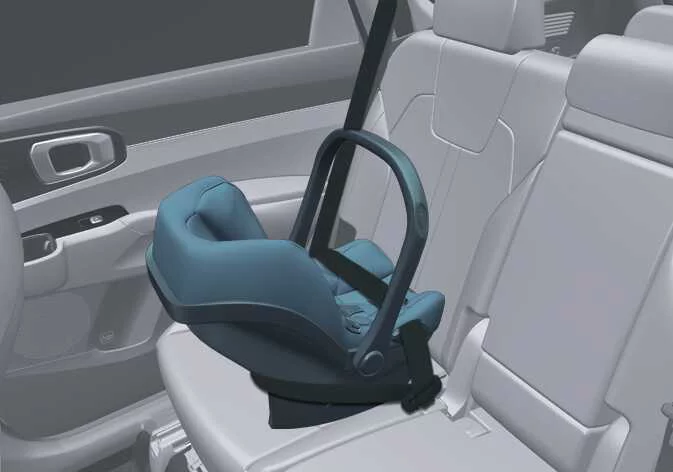
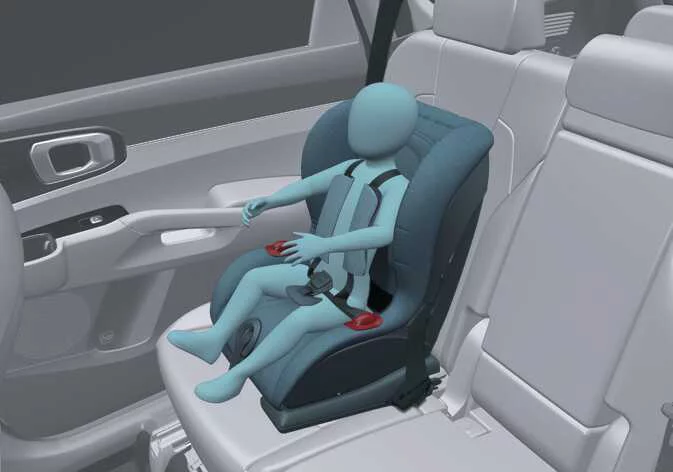
Child Restraint Systems fall into three primary categories: rear-facing child seats, forward-facing child seats, and booster seats. These restraint systems are classified according to the occupant’s age, overall height, and body weight.
Rear-facing child seats
|
A rear-facing child seat cradles the child by distributing impact forces across the extended surface area of the seatback against the child’s back. An internal 5-point harness system holds the child firmly in place, keeping them securely positioned inside the protective shell during a collision to minimize crash stress on their delicate neck and spinal cord.
Infants under one year of age must always ride in a rear-facing Child Restraint System.
Modern convertible and 3-in-1 child safety seats feature expanded height and weight limits for rear-facing usage, allowing parents to keep young children riding rear-facing for an extended timeframe.
Continue utilizing a rear-facing child seat for as long as your child remains within the height and weight restrictions specified by the seat manufacturer. This remains the safest travel orientation for infants and toddlers. Once your child outgrows the maximum rear-facing thresholds, transition them to a forward-facing CRS equipped with an internal harness.
Forward-facing child restraints
|
A forward-facing child seat restrains the child’s body securely using an integrated harness structure. Keep your child in a harness-equipped forward-facing seat until they reach the maximum height or weight limit defined by your child seat manufacturer.
When your child exceeds the height or weight boundaries of their forward-facing harness seat, they are ready to advance to a belt-positioning booster seat.
Booster seats
A booster seat elevates the child to optimize the fit of the vehicle’s standard 3-point seat belt system. The booster properly routes the lap belt across the lap rather than the soft abdomen.
Keep your child using a booster seat until they are large enough to sit fully back against the vehicle seatback with their knees bent naturally over the seat edge while maintaining proper seat belt alignment. For a standard seat belt to fit correctly, the lap belt portion must lie flat and snug across the upper thighs—never across the stomach. The diagonal shoulder belt must rest comfortably across the middle of the shoulder and chest—never resting against the neck or face. Children under age 13 must always ride in the rear passenger seats of your Kia Sorento and remain properly restrained to minimize collision hazards.
 Children always in the rear
Children under 13 years of age must always ride seated in the rear passenger rows and must be properly secured in an
appropriate restraint system to minimize the risk of severe injury during a co ...
 Installing a child restraint system (CRS)
After selecting a compatible child seat for your child, verify that it fits firmly and securely in your vehicle
before traveling.
Always follow the exact mounting steps supplied by the child sea ...
See also:
Specification
Temperature
Resistance (kΩ)
°C
°F
-40
-40
48.14
-20
-4
14.13 ~ 16.83
0
32
5.7 ...
Power sunshade
The integrated power sunshade in your Kia Sorento allows you to easily ...
Front seat adjustment - power (if equipped)
The front seat can be adjusted by using the control switches located on the outside
of the seat cushion.
Before driving, adjust the seat to the proper position so you can easily control
the steerin ...