 Kia Sorento: Limitations of Forward Collision-Avoidance Assist
The operational range of the Forward Collision-Avoidance Assist system in your Kia Sorento may fluctuate depending on current traffic flow, the behavior of vehicles ahead, and environmental surroundings. Navigating at night poses specific challenges; the ability to detect other vehicles, motorcyclists, pedestrians, and cyclists is naturally reduced, which may lead to the system being temporarily limited or entirely unavailable. Furthermore, if your own vehicle or an oncoming vehicle is not traveling in a straight path, the Front Oncoming warning and intervention functions might experience delays or fail to engage. Similarly, if the angle of a potential collision with a crossing vehicle exceeds the system's design parameters, Junction Crossing alerts and control measures may not trigger as expected.
Emergency Steering functionality is designed to automatically conclude once the immediate risk factors have been mitigated. Be aware that Emergency Steering may deactivate mid-operation if the driver maintains a firm grip on the steering wheel or steers in the opposite direction. Additionally, while the system provides support to avoid collisions, Evasive Steering Assist will automatically deactivate if new collision risks with other vehicles, cyclists, or pedestrians are detected, or if the system determines there is insufficient physical space to execute a safe evasive maneuver. Please note that the Forward Collision-Avoidance Assist system is not programmed to activate for carts, bicycles, or various objects currently being pushed or pulled by pedestrians. Furthermore, strong electromagnetic interference can disrupt normal system operation, and there is a mandatory initialization period of approximately 15 seconds immediately following vehicle startup or front-view camera calibration during which the system may not activate.
Forward Collision-Avoidance Assist may exhibit abnormal or unexpected behavior under specific conditions, including, but not limited to:
-
Any sensor being physically obscured, damaged, or misaligned.
-
Ambient temperatures around the front-view camera being excessively high or low.
-
The camera lens being obstructed by windshield tints, films, coatings, or damage, as well as physical debris such as stickers or insects.
-
Accumulation of moisture, fog, or ice on the windshield.
-
Severe weather conditions including heavy rain, thick fog, or dense snowfall that obstructs the camera's line of sight.
-
Direct sun glare overwhelming the front-view camera’s field of view.
-
Distracting light reflections on wet road surfaces, such as deep puddles.
-
Objects placed on the instrument panel reflecting onto the windshield.
-
Driving through environments that are either excessively bright or near-total darkness.
-
Rapid light transitions, such as the sudden change when entering or exiting tunnels.
-
Operating in dark conditions without active or properly functioning headlights.
-
Objects or road users being only partially visible to the sensors.
-
The presence of large vehicles ahead, such as buses, heavy trucks, or those with bulky, protruding cargo and trailers.
-
Vehicles or motorcyclists ahead that lack standard tail lights or utilize non-standard light configurations.
-
Vehicles with abnormally low or high ground clearance.
-
Sudden lane-cutting maneuvers by other road users directly ahead of your Kia Sorento.
-
The front radar sensor being damaged or out of factory alignment.
-
Extreme temperature fluctuations surrounding the front radar unit.
-
Driving through sparse environments with few reference points, such as deserts or open meadows.
-
Navigating areas with significant metallic interference, such as construction zones, railroad crossings, or roads plated with metal.
-
Shadows cast across lane markings by noise barriers, trees, guardrails, or median strips.
-
Sudden obstruction of your view of the vehicle ahead.
-
Abrupt lane changes or deceleration by the vehicle or motorcyclist ahead.
-
The vehicle ahead being heavily covered in snow.
-
Your own vehicle departing from or returning to a lane.
-
Unstable driving dynamics or erratic vehicle movement.
-
Navigating traffic circles where road curvature impedes the detection of oncoming vehicles.
-
Driving on steep inclines or declines that position vehicles outside the effective range of the camera or radar.
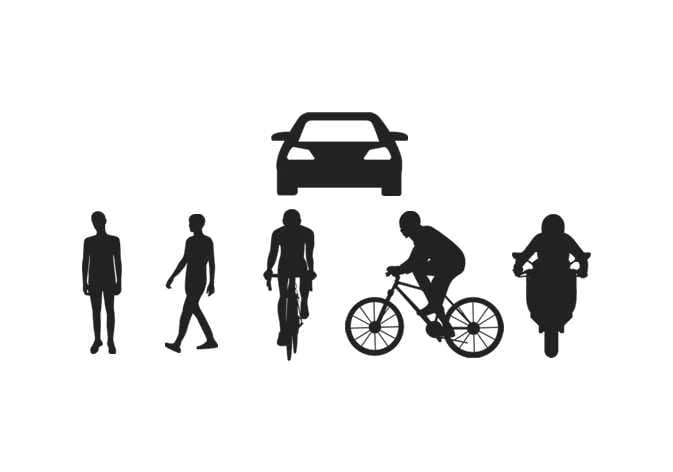
The following illustration outlines the types of road users that the front-view camera and radar on your Kia Sorento are designed to detect:
|
Detection performance for pedestrians or cyclists may be compromised if they are:
-
Leaning over rather than walking in a fully upright posture.
-
Wearing specialized clothing or carrying equipment that camouflages them against the background.
-
Moving at exceptionally high speeds across your path.
-
Short in stature or in a crouching position.
-
Moving against the flow of traffic or displaying signs of impaired mobility.
-
Part of a large, dense crowd.
-
Visually indistinguishable from their surroundings.
Furthermore, system limitations apply when driving through or near the following scenarios:
-
Driving through steam, heavy smoke, or deep shadows.
-
Passing through tunnels or crossing steel-structured bridges.
-
Wide, open areas with few structures, including fields, suburbs, or deserts.
-
Within busy parking lot environments.
-
Navigating tollgates, active construction sites, or extremely rough, bumpy terrain.
-
Areas with high concentrations of metal, such as railroad yards.
-
Steep, winding, or complex road geometries.
-
Roadsides densely lined with street lights or trees.
-
Narrow roads surrounded by dense vegetation or overgrowth.
-
Areas with high levels of electrical noise or strong radio wave interference.
-
When using snow chains, a temporary spare tire, or non-standard wheel sizes.
Junction Crossing, Lane-Change Oncoming, Lane-Change Side, Evasive Steering Assist function (if equipped)
These advanced driver assistance functions may demonstrate abnormal or unexpected behavior if subjected to the following conditions:
-
Temperature extremes around the front or rear corner radar units.
-
Installation of aftermarket trailers or carriers in close proximity to the rear corner radar sensors.
-
Accumulation of rain, snow, dirt, or other foreign matter on the radar sensors.
-
Obstruction of the bumper near radar units by bumper guards, stickers, or bike racks.
-
Structural damage or misalignment of the bumper or radar components.
-
Blockage of sensors by pillars, walls, or other stationary vehicles.
-
Navigating highway exit or entry ramps.
-
Driving alongside high walls or tall guardrails.
-
Other road users passing extremely close to your vehicle.
-
High-speed passing maneuvers by other vehicles.
-
Your vehicle performing a pass of another road user.
-
Accelerating at speeds matching a vehicle in the adjacent lane.
-
Dynamic lane merging or changing maneuvers by you or nearby drivers.
-
Detection of motorcycles or bicycles.
-
Detection of large, flat-bed trailers.
-
Detection of heavy vehicles like large trucks or commercial buses.
-
Detection of small moving obstacles such as strollers, shopping carts, or animals.
-
Detection of lower-profile vehicles such as sports cars.
-
Poor lane visibility due to oil, sand, water, or other debris.
-
Obscured or non-distinct lane markings.
-
Merging lanes or the sudden termination of lane markings.
-
Roads featuring more than two lane markings or complex roadwork patterns.
-
Road markings like crosswalks, zigzag lines, or temporary signage.
-
Abrupt disappearance of lanes at intersections.
-
Abnormally wide or narrow lane widths.
-
Lane markings hidden by a vehicle directly ahead.
-
Following a lead vehicle too closely.
TIP: For additional details regarding the limitations of rear corner vehicle detection and safety precautions for these sensors, please consult the section dedicated to Blind-Spot Collision-Avoidance Assist (BCA).
WARNING
-
Driving on a curved road
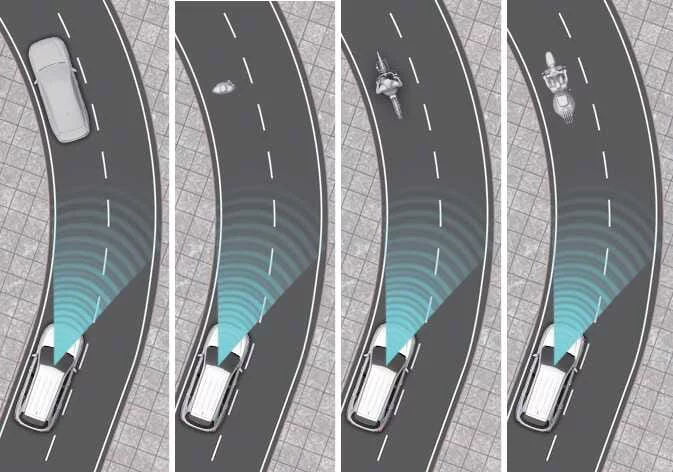
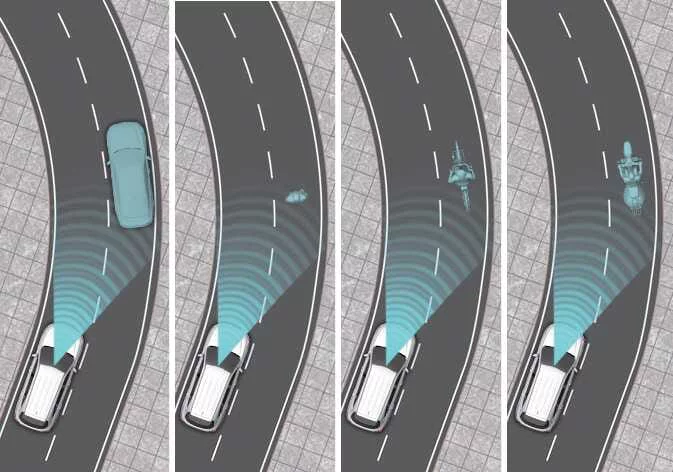
Forward Collision-Avoidance Assist may fail to detect objects ahead when driving on curved roads, potentially resulting in delayed warnings or a lack of automatic braking and steering. When negotiating curves, always maintain a safe distance and be prepared to take manual control of the brakes and steering. Occasionally, the system may incorrectly detect objects in adjacent lanes while cornering; always remain vigilant and monitor traffic conditions manually.
-
Driving on an incline
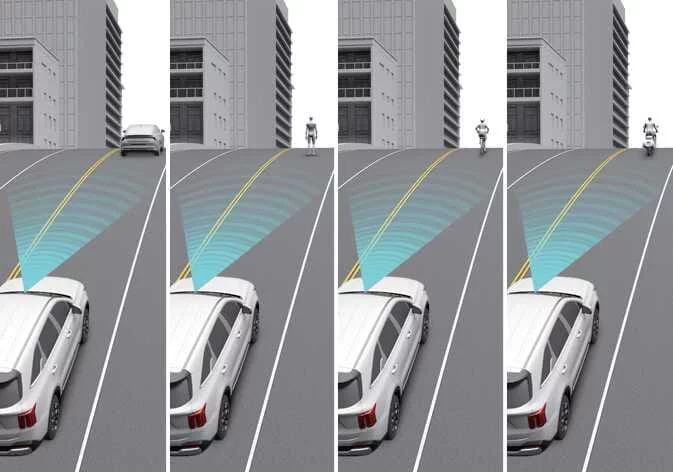
Driving on steep uphill or downhill gradients can adversely affect sensor performance, potentially causing the system to miss obstacles. Always keep your eyes on the road, manage your speed manually, and maintain appropriate braking distances regardless of system status.
-
Changing lanes
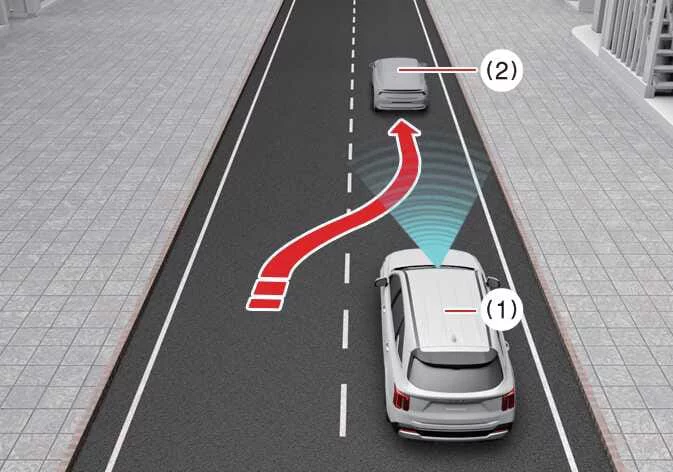
-
Your vehicle
-
Lane changing vehicle or motorcyclist
Vehicles merging into your lane from an adjacent lane may not be detected until they are well within the sensor range. Exercise caution during abrupt lane changes by other drivers and maintain a safe following distance. Similarly, when the vehicle ahead merges into another lane, the system may not immediately identify a new vehicle that was previously hidden. Always maintain a safe braking distance and be ready to manually adjust your speed.
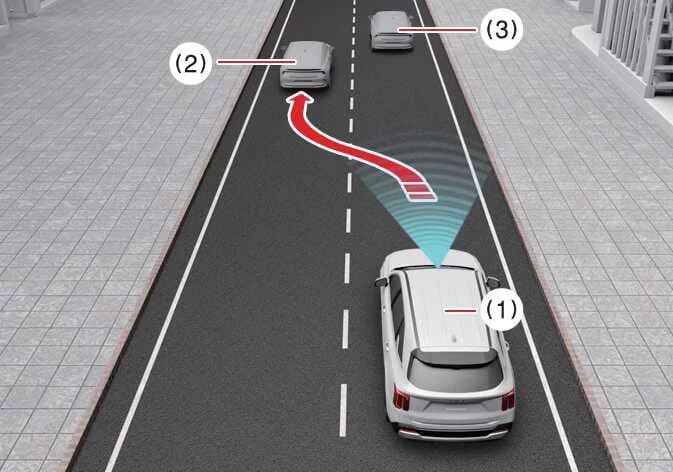
-
Your vehicle
-
Lane changing vehicle or motorcyclist
-
Same lane vehicle
-
-
Detecting a vehicle
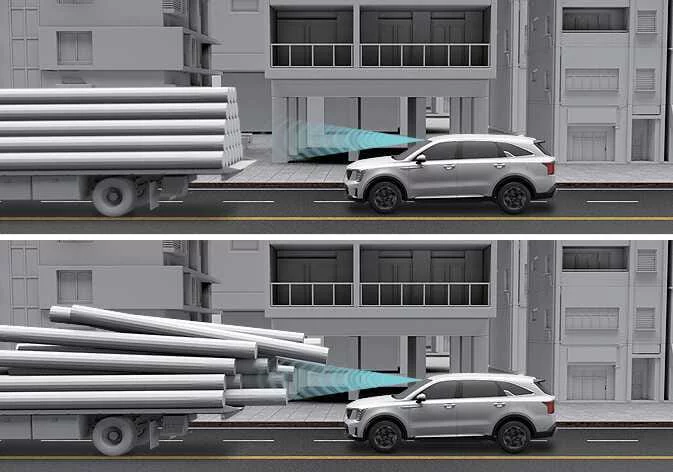
Exercise extreme caution when following vehicles with high ground clearance or cargo that extends significantly beyond the rear of the vehicle, as Forward Collision-Avoidance Assist may fail to identify these objects. Always maintain a safe distance from the rearmost part of such vehicles.
TIP:
-
Deactivate Forward Collision-Avoidance Assist whenever towing a trailer or another vehicle for safety.
-
The system may occasionally trigger based on objects that resemble road users.
-
Forward Collision-Avoidance Assist does not recognize carts or bicycles being moved by pedestrians.
-
Strong electromagnetic fields may disrupt normal operation.
-
The system requires a 15-second initialization window after vehicle startup.
TIP: For additional details regarding the limitations of rear corner vehicle detection and safety precautions for these sensors, please consult the section dedicated to Blind-Spot Collision-Avoidance Assist (BCA).
This device complies with Part 15 of the FCC rules.
Operation is subject to the following two conditions:
-
This device may not cause harmful interference, and
-
this device must accept any interference received, including interference that may cause undesired operation.
TIP: Changes or modifications not expressly approved by the party responsible for compliance could void the user’s authority to operate the equipment.
 Forward Collision-Avoidance Assist malfunction
 Lane Keeping Assist (LKA)
See also:
Mode Control Actuator Inspection
1.
Turn the ignition switch OFF.
2.
Disconnect the mode control actuator connector.
3.
Verify that the mode con ...
Seat warmer (if equipped)
The seat warmer is provided to warm the front seats during cold weather.
With the ignition switch in the ON position, push either of the switches to warm
the driver's seat or the front passeng ...
Hood
The hood serves as the primary protective engine cover for the motor compartment of your vehicle.
Open the hood whenever you need to inspect fluid levels, perform routine maintenance, or carry out ...
Manuals list
- Kia Sorento MQ4 2021-2026 Owners Manual
- Kia Sorento XM 2011-2015 Owners Manual
- Kia Sorento XM 2011-2015 Service Manual
