
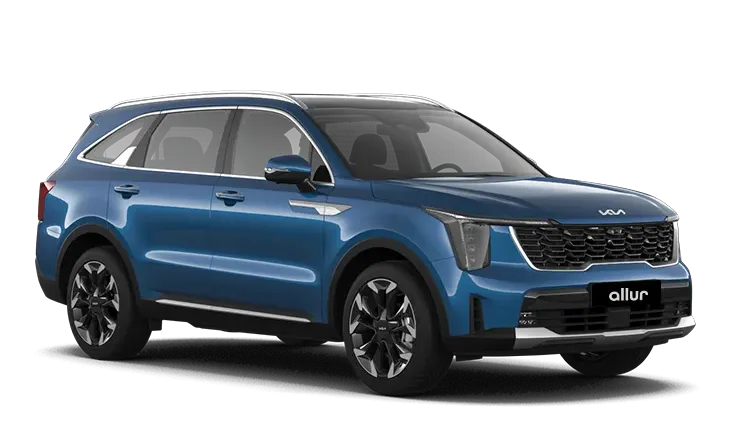
 Kia Sorento: Emergency starting
When your Kia Sorento fails to crank because of a depleted or low-capacity battery, you may need to perform an emergency jump start to restore electrical power.
Jump starting. Jump starting instructions
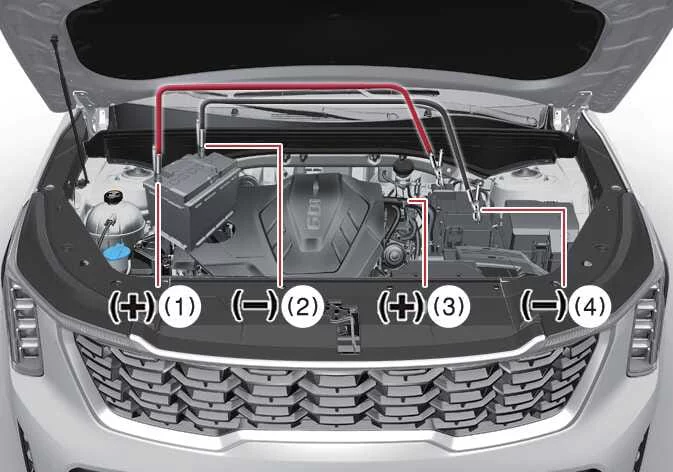
Connect the booster cables strictly in the exact numerical sequence illustrated in the following diagram, and disconnect them in the exact reverse order:
|
Performing an emergency jump start can present safety risks if executed improperly. To prevent personal injury or harm to your Kia Sorento electrical architecture and battery, adhere strictly to the standardized jump-starting protocols outlined in this section. If you harbor any doubts regarding your capability, enlist a qualified automotive technician or professional towing service.
NOTE
Always utilize a standard 12-volt auxiliary jump-starting power source. Connecting a 24-volt power setup—such as two 12-volt batteries wired in series or a heavy-duty 24-volt commercial generator—can inflict catastrophic, unrepairable damage on the 12-volt starting motor, computerized ignition modules, and sensitive onboard electrical components.
WARNING
Frozen batteries
Never attempt to jump start your Kia Sorento if the discharged vehicle battery is frozen solid, as a frozen housing risks rupturing or violently exploding.
WARNING
Battery
-
Never attempt to pry open or check the internal electrolyte fluid levels of a maintenance-free battery, as this dangerous action can cause the casing to rupture or explode.
-
Keep all open flames, sparks, and smoking materials far away from the battery housing. Lead-acid batteries naturally emit highly flammable hydrogen gas, which can trigger a severe explosion when exposed to sparks or ignition sources.
Failing to follow these mandatory safety directives precisely can result in severe physical injuries and expensive vehicle damage. If you feel uncertain about executing any step of this procedure, seek professional assistance immediately. Automotive storage batteries contain concentrated sulfuric acid, which is highly toxic and corrosive. Always wear protective safety eyewear during jump-starting operations and take meticulous care to prevent acid from splashing onto your skin, garments, or painted vehicle surfaces.
-
Do not attempt to jump start your Kia Sorento if the discharged battery is suspected to be frozen or if the internal electrolyte volume is visibly compromised, as the battery may rupture or shatter.
-
Never allow the positive (+) and negative (-) jumper cable clamps to touch one another while connected to a live power source, as this generates dangerous electrical sparks.
WARNING
Battery cables
Never connect the negative jumper cable directly from the negative terminal of the booster power source to the negative terminal of the discharged Kia Sorento battery. Doing so forces high charging currents through the dead battery, causing it to overheat, warp, crack, or degrade prematurely. Instead, connect one clamp to the negative terminal of the booster battery and attach the opposing clamp firmly to a solid, unpainted metallic grounding point located safely away from the battery compartment.
WARNING
Sulfuric acid risk
Automotive batteries contain concentrated sulfuric acid. Exercise extreme caution during emergency jump-starting procedures to ensure that acid does not come into contact with your skin, clothing, or vehicle body panels, as this chemical is highly poisonous and exceptionally corrosive.
Jump starting instructions
- Make sure the booster battery is 12-volt and that its negative terminal is properly grounded to complete the circuit safely.
If the booster battery is housed within another donor vehicle, take meticulous care to ensure that the two vehicles do not come into physical contact with each other.
- Turn OFF all unnecessary electronic accessories, lights, and climate control loads on your Kia Sorento to reduce electrical draw.
- Connect the booster jumper cables in the exact numerical sequence illustrated in the following diagram:
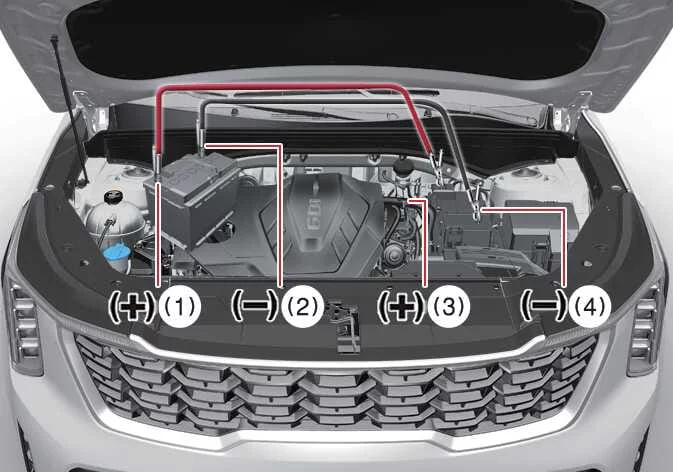
- Connect one end of the first jumper cable directly to the positive (+) terminal of the discharged Kia Sorento battery (3).
- Connect the opposite end of that same jumper cable to the positive (+) terminal of the external booster battery (1).
- Connect one end of the second jumper cable to the negative (-) terminal of the booster battery (2).
- Connect the remaining end of that second jumper cable to a secure, unpainted metallic engine ground point—such as the heavy-duty engine lifting bracket—located safely away from the battery housing (4).
Never allow the exposed jumper cable clamps to touch any surrounding components other than the specified battery terminals or approved grounding points. Avoid leaning directly over the battery assembly while attaching the live cables.
- If you have established a cable connection with a donor vehicle, start the engine of the assisting vehicle first and allow it to run steadily at approximately 2,000 rpm for several minutes to build a proper charge.
- Attempt to start the engine of your Kia Sorento containing the discharged battery.
- Once your engine successfully fires up and runs smoothly, carefully disconnect the cables in the reverse order of attachment, beginning by removing the negative cable end from the booster battery (2), followed by disconnecting the positive clamps from the booster battery (1) and your vehicle battery (3).
If there is no obvious explanation for why your battery lost its charge—such as leaving interior lights on—have your electrical charging system thoroughly inspected by an authorized Kia dealership.
NOTE
Battery cables
Never hook up the negative jumper cable directly from the negative terminal of the booster power source to the negative terminal of the discharged Kia Sorento battery. Doing so forces an unregulated surge through the dead battery, causing it to overheat, crack, and potentially spew dangerous acid.
Always ensure that you attach one end of the negative cable to the booster battery's negative terminal, and secure the opposite end to a robust, unpainted metallic structural point far away from the battery compartment.
Push starting
Kia Sorento models equipped with an automatic transmission or a modern Dual Clutch Transmission (DCT) cannot be push-started under any circumstances; they must instead be recovered via proper jump-starting methods. Follow the detailed jump-starting protocols outlined earlier in this section.
WARNING
Tow starting the vehicle
Never attempt to tow your Kia Sorento to start the engine. The moment the engine catches and fires up, your vehicle can surge forward unexpectedly and collide forcefully with the vehicle towing it.
 Road warning. Hazard lights switch. If the engine does not start
 If the engine overheats. In case of an emergency while driving
See also:
Side Airbag (SAB) Module Installation
Be sure to install the harness wires not to be pinched or interfered
with other parts.
...
Components Location
1. Automatic transaxle
2. Shift cable bracket
3. Inhibitor switch connector
4. Manual control lever
5. Automatic transaxle mounting support bracket
6. Solenoid valve conne ...
LCD display messages
Door, hood, liftgate, or sunroof open
This warn ...
Manuals list
- Kia Sorento MQ4 2021-2026 Owners Manual
- Kia Sorento XM 2011-2015 Owners Manual
- Kia Sorento XM 2011-2015 Service Manual
