
 Kia Sorento: Description and Operation
Kia Sorento (MQ4, 2021-2026) Service Manual / Suspension System / Alignment / Description and Operation
| Description |
| • |
Wheel alignment is all forces due to friction, gravity, centrifugal force and inertia operate in a balanced
manner while driving.
|
| • |
Wheel alignment improves linearity, grounding performance, tire life extension and fuel reduction and
ensures safety at high speeds.
|
| • |
Alignment adjustments consist of camber, castor, kingpin angle, toe, left, thrust angle, etc.
|
| Components |
Camber
Camber refers to the angle at which the top of the wheel is tilted inward or outward relative to the vertical line
started from the center of the floor when the vehicle is viewed from the front.
| – |
It facilitates steering control of the steering wheel and prevents bending of the front axle.
|
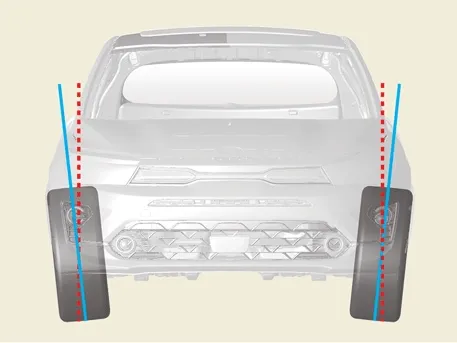
[Plus ( + ) Camber]
It is a camber form with wheels tilted outward from the top. It prevents the underside of the wheel from opening,
so there is less tire wear due to unnecessary driving resistance on curves.
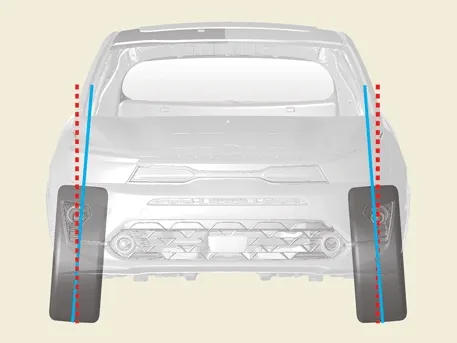
[Minus (-) Camber]
It is a camber form with wheels tilted inward from the top. cause strong friction when driving curves but tires are
prone to wear.
Caster
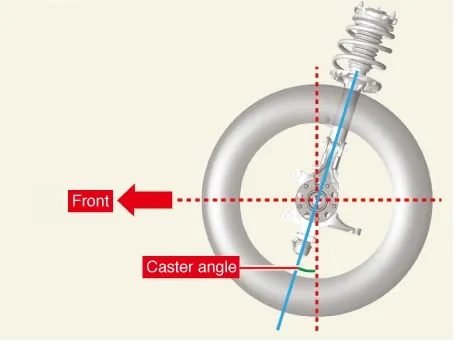
Caster refers to the angle at which the steering shaft tilts forward and backward relative to the vertical line
initiated from the center of the wheel floor when the vehicle is viewed from the side.
| – |
It gives a straight line to the steering wheel when driving.
|
| – |
Provides resilience to wheels when steering.
|
| – |
It prevents shaking of wheels while driving.
|
King pin angle
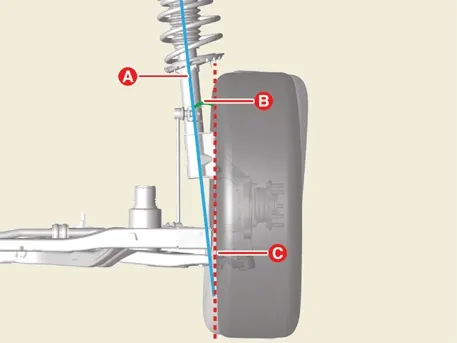
Kingpin angle refers to the angle at which the centerline of the steering shaft and the bottom vertical line forms
when the vehicle is viewed from the front.
| – |
Provides easy steering of the steering wheel and resilience of the steering wheel.
|
| – |
The kingpin angle and camber are also called Included Angle (I.A.). [Included Angle (I.A.)]
|
|
Item |
Descriptions |
|
A |
Steering Center Line |
|
B |
Kingpin |
|
C |
Center line |
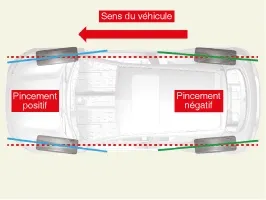
Toe
Toe is the tilted angle or distance at the front of the wheel when looking up and down at the vehicle.
| – |
The state in which the front of the wheel faces outward is called Toe out, and the state in which the front
of the wheel faces inward is called Toe in.
|
| – |
In general vehicles, toe-in is applied to prevent side slip.
A phenomenon in which the wheels slide sideways due to the influence of the camber while the vehicle is
driving.
|
| – |
Tow-out is sometimes applied to vehicles that require a fast steering response when turning.
|
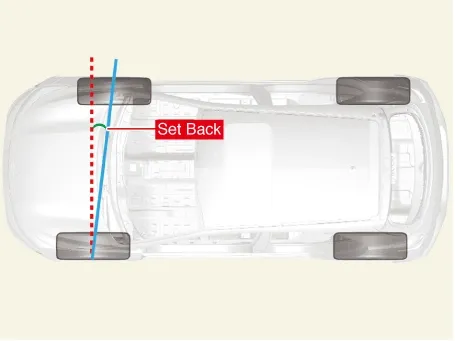
Set Back
Set back refers to the angle at which the line connects the center of the front wheels from the vehicle's
centerline.
| – |
The main cause of the set back is the presence of an accident in the vehicle or an abnormality in the body.
|
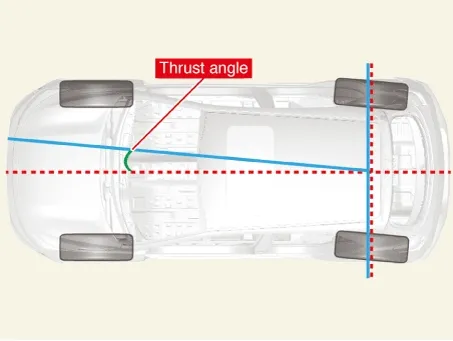
Thrust angle
The angle at which the Thrust line and the centerline of the vehicle are formed.
※Thrust line: A line that is perpendicular to the center line of the vehicle and the center line of the rear axle.
| – |
Thrust conditions occur when the rear wheel individual toe is not the same.
|
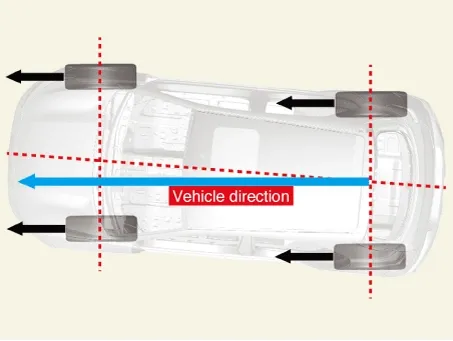
Poor thrust angles can increase tire wear, reduce steering direction, and cause dog tracking.
※Dog tracking: The driving condition when the thrust line is not parallel to the center line of the vehicle
|

...
 Alignment
On Vehicle Inspection
Driving test
Carry out pre-work vehicle driving tests to check vehicle behavior under normal driving conditions.
On straight, flat road
...
 On Vehicle Inspection
See also:
Lubricant
Lubricants
Front Driveshaft
Joint
Lubricants
Quantity
LH
RH
H ...
Drive Belt Tensioner Repair procedures
Removal and Installation
Drive Belt Tensioner
1.
Remove the drive belt.
(Refer to Drive Belt System - "Drive Belt" ...
Curtain Airbag (CAB) Module Installation
1.
Remove the ignition key from the vehicle.
2.
Disconnect the battery negative cable and wait for at least thirty
seconds.
...
Manuals list
- Kia Sorento MQ4 2021-2026 Owners Manual
- Kia Sorento XM 2011-2015 Owners Manual
- Kia Sorento XM 2011-2015 Service Manual

Copyright © www.ksmanual.com 2014-2026 - 0.0529