
 Kia Sorento: Why didn’t my air bag go off in a collision? (Inflation and non-inflation conditions of the air bag). Supplemental Restraint System (SRS) care
Why didn’t my air bag go off in a collision? (Inflation and non-inflation conditions of the air bag)
Many types of vehicular accidents do not generate the specific deceleration vectors or force thresholds required for airbags to provide additional protective benefits.
Such scenarios include rear-end collisions, secondary or tertiary impacts during complex multi-vehicle accidents, and low-speed parking lot bumps where standard seat belt tensioning provides more than adequate restraint.
Air bag inflation conditions
Front air bags

|
Front airbags inflate during a frontal collision based on a complex algorithm of evaluation factors, primarily focusing on the immediate severity and deceleration rate of the frontal impact experienced by the Kia Sorento structure.
Side and curtain air bags

|
The actual size, shape, and deployment coverage of airbags in your vehicle may differ from printed manual illustrations due to continuous design enhancements.
Side and curtain airbags deploy when specialized lateral collision sensors record an impact force that meets or exceeds calibration thresholds, depending heavily on the severity and angle of the side crash.
Furthermore, side and curtain airbags inflate automatically the moment integrated gyroscopic rollover sensors detect an imminent rollover trajectory.
Although driver and front passenger front airbags primarily deploy during head-on collisions, they may also actuate in other collision types if front-mounted impact sensors record sufficient longitudinal deceleration force.
Similarly, while side and curtain airbags are engineered for lateral impacts, they can deploy in other accident configurations if sensors detect severe sideways forces. For example, side or curtain airbags may trigger if rollover sensors calculate a high risk of tipping—even if a complete rollover does not occur—or during specialized situations such as severe vehicle tilting while being towed.
Even if side or curtain airbags cannot alter impact forces during certain rollover events, they will deploy rapidly to prevent occupant ejection, especially for passengers properly restrained by seat belts.
Driving aggressively over deep bumps or striking hard obstacles on rough, unimproved roads can generate heavy chassis shocks that trick sensors into deploying airbags. Always drive with extreme caution on unpaved tracks or surfaces not designed for normal vehicle traffic to avoid accidental airbag deployment in your Kia Sorento.
Air bag non-inflation conditions
-
Airbags may remain inactive during minor, low-speed collisions where deployment would not offer any enhanced protection beyond the high-efficiency restraint already delivered by the emergency-locking seat belts.
-
Front airbags are intentionally designed not to inflate during rear-end collisions, as the physics of the crash hurls occupants backward against the seatback. In this scenario, front-deploying cushions would offer zero added safety benefit.
-
Front airbags may not deploy during pure side-impact collisions because occupants naturally shift laterally toward the point of impact. Consequently, frontal airbag deployment would fail to provide any useful protection during a direct side crash.
-
During angled or offset glancing collisions, the directional vector of the impact force can push occupants away from optimal zones, rendering airbags ineffective; therefore, the control module may choose not to deploy them.
-
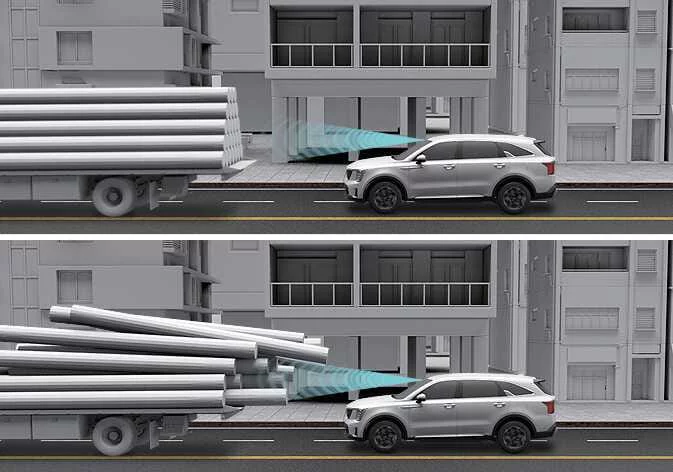
Just prior to a crash, drivers often slam on the brakes. Heavy emergency braking compresses the front suspension, causing the nose of the Kia Sorento to dive and potentially slide underneath the rear bumper of a higher-clearance vehicle. Airbags may fail to inflate in these “under-ride” accidents because the primary deceleration spike recorded by front sensors is drastically reduced.
-
Front airbags may not activate during specific rollover accidents if the SRS Control Module (SRSCM) calculates that front airbag deployment would fail to deliver any additional structural protection to the occupants.
-
Airbags may remain uninflated if the vehicle strikes a narrow, isolated obstacle such as a utility pole, tree, or metal post. Because crash energy is concentrated entirely within a single localized point, the full structural deceleration force fails to distribute broadly across the chassis sensors.
Supplemental Restraint System (SRS) care
The advanced Supplemental Restraint System (SRS) integrated into your Kia Sorento is engineered to be virtually maintenance-free under normal operating conditions, meaning there are no internal mechanical or electronic components that owners can safely service or adjust independently.
The Supplemental Restraint System (SRS) of your Kia Sorento is engineered to be virtually maintenance-free, so there are no serviceable parts that require owner intervention or independent mechanical adjustments.
If the dashboard SRS airbag warning light fails to illuminate during the initial ignition check sequence, or if it remains continuously illuminated while driving, you should have your vehicle inspected immediately by an authorized Kia dealership.
Any technical intervention involving the SRS—such as removing, installing, repairing, or working near the steering wheel hub, the front passenger panel, front seat assemblies, and roof rail curtain modules—must be performed exclusively by certified technicians at an authorized Kia dealership. Improper handling or unauthorized tampering with delicate SRS wiring and explosive actuators can result in severe personal injury.
When cleaning the airbag pad covers throughout the cabin of your Kia Sorento, use only a soft, dry microfiber cloth or one lightly moistened with plain water. Chemical solvents, aggressive household cleaners, or petroleum-based wipes can degrade the polymer cover materials and compromise proper airbag deployment performance during an accident.
If you ever need to dispose of individual airbag system components or prepare your Kia Sorento for permanent scrapping, strict safety precautions must be followed. An authorized Kia dealer possesses the mandatory training and safety protocols to handle these components safely. Failure to adhere to these procedures significantly increases the risk of bodily harm.
WARNING
Tampering with SRS
Never tamper with, modify, splice, or disconnect SRS wiring harnesses or any internal components of the Supplemental Restraint System. Unauthorized modifications can trigger accidental airbag inflation or permanently render the entire safety restraint system inoperative.
WARNING
Towing vehicle
Always ensure the ignition switch is turned completely off and wait at least 3 minutes before your Kia Sorento is towed. The sensitive onboard gyroscopic rollover sensors can mistakenly interpret the tilting motion during towing as a rollover event, potentially causing the side and curtain airbags to deploy unexpectedly.
 Curtain air bag. Air bag collision sensors
 Additional safety precautions. Adding equipment to or modifying your air bag-equipped vehicle
See also:
Steering Column and Shaft Removal
1.
Disconnect the battery negative cable from the battery and then
wait for at least 30 seconds.
2.
Turn the steering wheel so that the fro ...
Towing
If the vehicle needs to be towed, call a professional towing service. Never tow
vehicle with just a rope or chain. It is very dangerous.[Front]
[Rear]
Emergency Towing
There are three popul ...
Fuel Pressure Regulator Removal
1.
Remove the fuel pump.
(Refer to Fuel Delivery System - ...
Manuals list
- Kia Sorento MQ4 2021-2026 Owners Manual
- Kia Sorento XM 2011-2015 Owners Manual
- Kia Sorento XM 2011-2015 Service Manual
