
 Kia Sorento: Winter driving
Harsh winter conditions present unique challenges that can accelerate tire wear and impact the overall performance of your Kia Sorento. Adapting your driving habits and ensuring your vehicle is properly prepared are essential steps to navigate seasonal hazards safely and reliably.
To minimize issues related to winter driving, you should follow the professional suggestions outlined in these sections:
Snowy or icy conditions
Navigating deep snow or ice safely may require specialized equipment, such as dedicated snow tires or appropriate tire chains. When selecting snow tires, always prioritize choosing the exact size and type as your original equipment to maintain the precise safety standards and handling characteristics engineered into your Kia Sorento. Avoid aggressive driving behaviors like speeding, rapid acceleration, sudden braking, or sharp steering inputs, as these significantly increase the risk of losing control on slick surfaces. When decelerating, leverage engine braking to maintain better vehicle stability. Always maintain a generous following distance, and when you do need to stop, engage the brake pedal with smooth, gradual pressure to prevent skidding. While tire chains significantly improve traction in deep snow, they do not eliminate the risk of side skidding, and their use is subject to regional regulations, so verify local laws before installation.
Snow tires
If you choose to equip your Kia Sorento with snow tires, ensure they are radial tires that match the original size and load-bearing specifications. For consistent handling and balanced performance across all four wheels, it is strongly recommended to install snow tires on all positions. Be aware that the compound of snow tires may offer reduced grip compared to your standard tires on dry pavement; therefore, adjust your speed and driving style accordingly even when roads appear clear. Always consult with your tire specialist regarding recommended speed limits for your specific tire model. If you are considering studded tires, confirm they are permitted by checking local, state, and municipal regulations, as many areas impose strict restrictions on their use to protect road surfaces.
WARNING
Snow tire size
To preserve the intended safety, suspension geometry, and handling balance of your Kia Sorento, snow tires must match the size and type of the original factory-fitted tires. Utilizing mismatched sizes can lead to unpredictable vehicle behavior in critical situations.
Tire chains
|
|
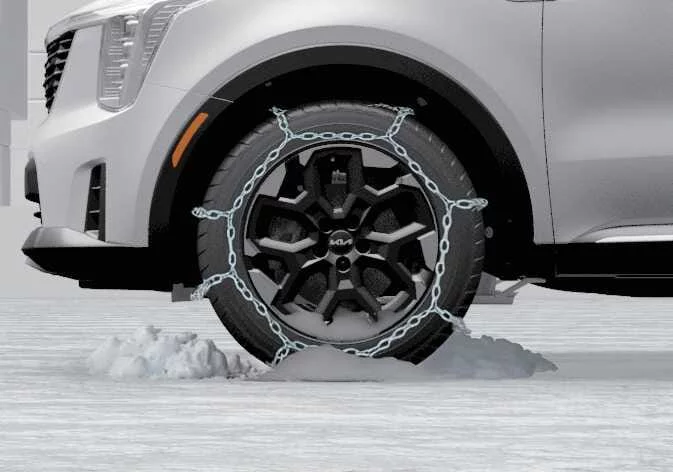
Due to the thin sidewall construction of modern radial tires, improper chain selection can result in severe tire damage. Generally, we recommend the use of winter-specific snow tires over chains. Furthermore, standard metal chains should never be mounted on vehicles equipped with aluminum wheels, as they can cause significant aesthetic and structural damage. If your local conditions necessitate the use of chains, adhere to these specific requirements:
-
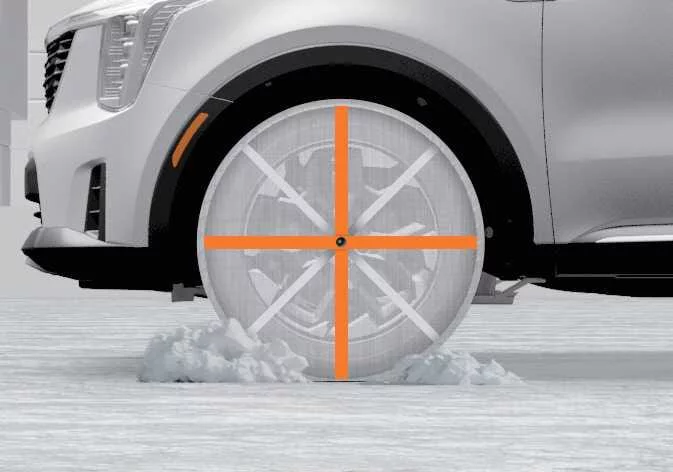
Use only fabric-type traction aids for vehicles equipped with 20-inch wheels.
-
Use wire-type chains with a thickness of less than 0.47 in (12 mm) for vehicles equipped with 17 or 18-inch wheels.
Please note that any damage resulting from the improper selection or installation of tire chains is not covered by your vehicle warranty. When installing chains, ensure they are secured to the drive wheels:
-
For Front Wheel Drive (FWD) or All-Wheel Drive (AWD) Kia Sorento models, tire chains must be installed on the front tires.
-
On AWD models, limit the distance driven with chains to the absolute minimum required to navigate hazardous terrain to protect the complex drivetrain components.
-
After installation, maintain a low speed. Should you hear metallic clicking or contact noise, reduce speed immediately. Once you reach cleared pavement, remove the chains promptly to prevent damage to your wheels and suspension.
-
Improperly sized or loose chains can strike brake lines, suspension arms, and body panels. Follow the manufacturer's installation manual carefully, ensure maximum tension, and never exceed 20 mph (30 km/h) while chains are in use.
CAUTION
-
Verify that your tire chains are the correct size and type. Using incompatible chains can cause substantial damage to your Kia Sorento's body and suspension, which is typically excluded from warranty coverage. Ensure that all chains are SAE class “S” certified to guarantee they fit within the wheel well clearance.
-
After traveling approximately 0.3 to 0.6 miles (0.5 to 1 km), stop the vehicle to inspect the chains. Check for sagging or loosening and retighten them as necessary to ensure a secure fit.
-
Specifically for 20-inch (255/45R20) tires, you are required to use fabric-type chains to maintain proper clearance and safety.
Use high quality ethylene glycol coolant
Your Kia Sorento is factory-filled with high-grade ethylene glycol coolant, which is essential for protecting the cooling system against internal corrosion, lubricating the water pump, and preventing freezing in sub-zero temperatures. Adhere strictly to the maintenance schedule for coolant replacement or top-offs. Before the onset of winter, we recommend having your cooling system tested by a professional to verify that the freezing point of the mixture remains adequate for the lowest expected temperatures in your region.
Check battery and cables
Cold weather significantly increases the electrical load on your battery, as the engine requires more power to start and the electrical system works harder to combat low temperatures. Perform a thorough visual inspection of the battery casing and cable connections as outlined in the Maintenance section. If you have concerns about starting reliability, visit an authorized Kia dealer to have the battery's state of charge and overall health professionally tested.
Change to “winter weight” oil if necessary
In regions experiencing extreme cold, transitioning to a lower viscosity “winter weight” engine oil can improve cold-start performance and engine protection. Please refer to your owner's manual section on Recommended lubricants and capacities for specific guidelines. If you require clarification on the most suitable oil grade for your specific climate, consult the service department at your authorized Kia dealer.
Check spark plugs and ignition system
A reliable ignition system is vital for cold-weather starts. Inspect your spark plugs according to the scheduled maintenance service intervals and replace them if there are signs of degradation. Additionally, check all ignition wiring, boots, and associated components to ensure they are free of cracks, heat damage, or signs of wear that could lead to engine misfires in damp or cold conditions.
To keep locks from freezing
To prevent door locks from seizing in freezing temperatures, apply a small amount of approved de-icer fluid or glycerin into the keyway. If a lock has already frozen, apply a specialized de-icing agent directly to the ice. In cases where the internal mechanism is frozen, a gently heated key may be used to thaw the lock; however, always handle heated keys with extreme caution to avoid potential burns.
Use approved window washer anti-freeze
Ensure your visibility is never compromised by using an approved window washer anti-freeze solution mixed according to the manufacturer's concentration guidelines. These products are readily available at authorized Kia dealers and reputable automotive retailers. Avoid using engine coolant or standard anti-freeze in the washer reservoir, as these substances can permanently damage your vehicle's paintwork and clear coat.
Don’t let your parking brake freeze
In extreme cold and wet conditions, an applied parking brake can potentially freeze in the engaged position, especially if snow or ice has accumulated around the rear brake assembly. If you anticipate such conditions, you may choose to park with the transmission in P (Park) and temporarily leave the parking brake disengaged. In this situation, always block the wheels securely to prevent the vehicle from rolling.
Don’t let ice and snow accumulate under your vehicle
Heavy snow or slush can pack into the wheel wells and undercarriage, potentially interfering with steering linkage or suspension travel. In severe weather, perform periodic inspections to ensure that ice buildup is not obstructing the movement of your wheels or essential steering components, which could compromise vehicle control.
Carry emergency equipment
Preparing for the unexpected is a hallmark of responsible winter driving. Depending on the typical severity of weather in your area, consider keeping a well-stocked emergency kit in your Kia Sorento. Recommended items include tire chains, tow straps, a high-intensity flashlight, emergency flares, a small bag of sand for traction, a sturdy shovel, jumper cables, an effective window scraper, heavy-duty gloves, a ground cloth, warm blankets, and extra clothing.
Do not place objects or materials in the engine compartment
Never place blankets, insulating materials, or other objects inside the engine bay in an attempt to keep the engine warm. These items can obstruct critical airflow, leading to rapid overheating or the risk of combustion if they contact hot engine components. Any damage resulting from such actions is not covered by the vehicle's warranty.
Drive your vehicle when water vapor condenses and accumulates inside the exhaust pipes
During the winter, short trips may cause water vapor to condense inside the exhaust system, as the pipes do not reach sufficient operating temperatures to fully evaporate the moisture. While this may cause temporary exhaust noise, driving your Kia Sorento at medium or high speeds for an extended period will allow the system to heat up and properly clear any accumulated condensate.
 Special driving conditions
 Trailer towing: (if equipped)
See also:
Removal
In case of removing the high pressure fuel pump, high pressure
fuel pipe, delivery pipe, and injector, there may be inju ...
Heater & A/C Control Unit (Manual) Replacement
1.
Disconnect the negative (-) battery terminal.
2.
Using a screwdriver or remover, remove the center fascia panel
(A).
...
Vehicle load limit
The official tire and loading information label affixed to the driver's side door frame explicitly displays your
specific Kia Sorento load limits.
Tire and loading information label
The certi ...
Manuals list
- Kia Sorento MQ4 2021-2026 Owners Manual
- Kia Sorento XM 2011-2015 Owners Manual
- Kia Sorento XM 2011-2015 Service Manual
