
 Kia Sorento: Troubleshooting
Kia Sorento (MQ4, 2021-2026) Service Manual / Brake System / Electronic Stability Control (ESC) / Troubleshooting
| Troubleshooting |
Failure Diagnosis
| 1. |
In principle, ESC and TCS controls are prohibited in case of ABS failure.
|
| 2. |
When ESC or TCS fails, only the failed system control is prohibited.
|
| 3. |
The solenoid valve relay should be turned off in case of ESC failure, refer to the ABS fail-safe.
|
| 4. |
Information on ABS fail-safe is identical to the fail-safe in systems where ESC is not installed.
|
Failure Code Memory
| 1. |
It keeps the code as far as the backup lamp power is connected.
|
| 2. |
It stores the code as long as HECU is powered ON.
|
Failure Test
| 1. |
Initial test is performed immediately after the HECU is powered on.
|
| 2. |
Valve relay test is performed immediately after switching "ON" the IG2.
|
| 3. |
Test are performed at all times the ignition (IG2) is ON.
|
| 4. |
Initial test is performed in the following cases.
|
| 5. |
Test continues even if the brake lamp is switched on.
|
| 6. |
When performing ABS or ESC control before the initial test, stop the initial test and wait for the HECU
power input again.
|
| 7. |
Determining failure in the following cases.
|
Failure Countermeasures
| 1. |
Turn the system down and perform the following actions and wait for HECU to power OFF.
|
| 2. |
Turn the valve relay off.
|
| 3. |
Stop the control during the operation and do not execute anything until it recovers to normal condition.
|
Warning Lamp ON
| 1. |
ESC warning lamps turns on for 3 seconds after IGN ON.
|
| 2. |
ESC function lamp blinks when ESC Activated.
|
| 3. |
In case of ESC failure, ESC warning lamp turns ON.
|
| 4. |
ESC OFF lamp turns on:
– When ESC is switched OFF
–3 seconds after IGN ON
|
Standard Flow of Diagnostic Troubleshooting
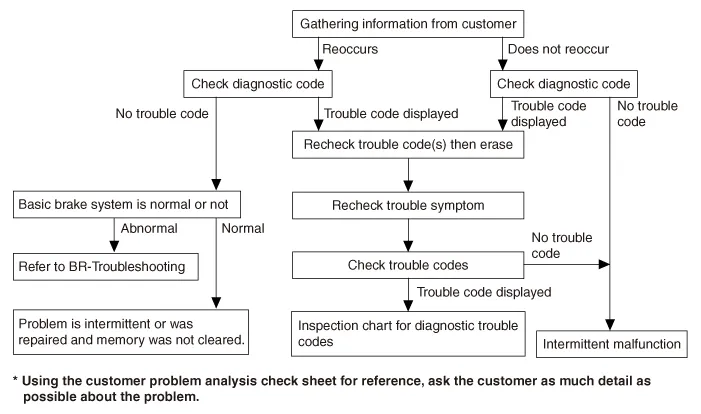
Notes With Regard To Diagnosis
The conditions listed in the following table are not abnormal.
|
Condition |
Explanation |
||||||
|
System check sound |
When starting the engine, a thudding sound can sometimes be heard coming from inside the engine compartment. This is because the system operation check is being performed. |
||||||
|
ESC operation sound |
|
||||||
|
ESC operation (Long braking distance) |
On snow-covered or gravel roads, the braking distance for vehicles with ABS can sometime be longer than that of
vehicles without ESC. Accordingly, advise customers to drive safely on such roads by reducing the vehicle
speed. |
||||||
| Diagnostic detection conditions can vary depending on the diagnostic code. When checking the trouble symptom after the diagnostic code has been erased, ensure that the requirements listed in "Comment" are met. |
|||||||
Checklist for diagnosis of ESC system
Before and after the ESC system test, Do these steps to check the integrity of the warning lamp and ESC system.
| 1. |
Inspection method
Turn on the IGN and check ABS system: If ABS/BRAKE warning lamp illuminate for 3 seconds, warning lamp and
ABS system are in normal condition.
|
| 2. |
If there are faults after self-test using KDS even if ESC system and warning lamp are in normal condition,
record the fault code and work with it.
|

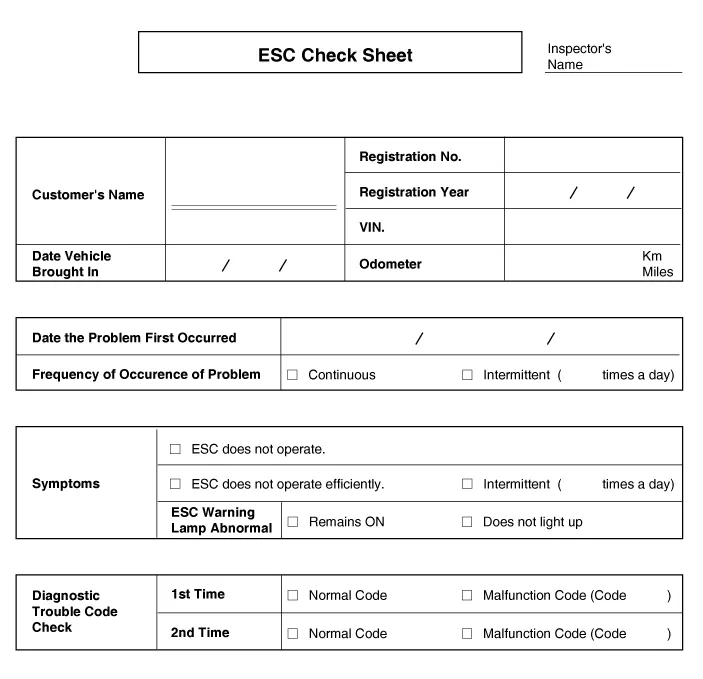
ESC Check Sheet
Problem Symptoms Table
|
Symptom |
Suspect Area |
||||||||
|
ESC does not operate. |
Only when 1 - 4 are all normal and the problem is still occurring, replace the HECU.
|
||||||||
|
ESC does not operate intermittently. |
Only when 1 - 4 are all normal and the problem is still occurring, replace the ESC actuator assembly.
|
||||||||
|
Communication with KDS is not possible. (Communication with any system is not possible) |
|
||||||||
|
Communication with KDS is not possible. (Communication with ESC only is not possible) |
|
||||||||
|
When ignition key is turned ON (engine OFF), the ESC warning lamp does not light up. |
|
||||||||
|
Even after the engine is started, the ESC warning lamp remains ON. |
|
During ESC operation, the brake pedal may vibrate or may not be able to be depressed. Such conditions are
due to intermittent changes in hydraulic pressure inside the brake line to prevent the wheels from locking and
is not an abnormality.
|

Description of ESC
Electronic Stability Control (ESC) recognizes critical driving conditions, such as panic reactions in dangerous
situations, and stabilizes the vehicle by individual ...
 Description and Operation
Components
1. Front Right (FR)2. Rear Left (RL)3. Rear
Right (RR)4. Front Left (FL)
5. Master Cylinder 16. Master Cylinder 27. ESC
Control u...
 ESC Control Unit Components and Components Location
See also:
Battery replacement
A smart key battery should last for several years, but if the smart key is not
working properly, try replacing the battery with a new one. If you are unsure how
to use your smart key or replace th ...
Input Speed Sensor Circuit Diagram
...
Audio system
NOTE
Installing aftermarket High Intensity Discharge (HID) headlights can introduce electrical interference,
causing
your Kia Sorento a ...
Manuals list
- Kia Sorento MQ4 2021-2026 Owners Manual
- Kia Sorento XM 2011-2015 Owners Manual
- Kia Sorento XM 2011-2015 Service Manual

Copyright © www.ksmanual.com 2014-2026 - 0.0454