
 Kia Sorento: Safe All Wheel Drive (AWD) operation. Driving in sand or mud
TIP
AWD
Compared to normal road conditions, on road or off road conditions that necessitate using AWD expose your Kia Sorento to extreme structural and mechanical stress. When utilizing the advanced AWD system, slow down and remain constantly alert for changes in the composition, grip, and traction of the road surface. If you ever have any doubt about the safety of upcoming road conditions, stop driving safely and consider the best way to proceed.
-
Do not drive through deep standing water or heavy mud, which can easily stall your engine and clog your exhaust pipes. Never attempt to drive down overly steep hills that require extreme driving skill just to maintain basic control of your vehicle.
-
When you drive up or down an incline, navigate the slope as straight as possible. When driving up or down a steep hill in your Kia Sorento, remain extremely cautious of potential vehicle rollover caused by severe grades, rough terrain, water accumulation, or deep mud.
WARNING
Hills
Traversing steep hills can be extremely dangerous due to slight changes in the wheel angle that can destabilize your vehicle. Your vehicle can become unstable if it stops its forward motion (even if your vehicle maintains stability under power). Your vehicle may roll over without warning or enough time for you to correct a mistake that could cause serious injury or death.
-
You must learn how to properly turn an all-wheel-drive vehicle. Do not rely entirely on your past experience with conventional Front Wheel Drive (FWD) vehicles when you execute turns in your Kia Sorento while operating in AWD mode. You must always drive more slowly when utilizing AWD.
WARNING
AWD
Reduce your speed when turning. AWD vehicles have a higher center of gravity than conventional FWD vehicles, and are more likely to roll over when you turn too quickly.

CAUTION
Steering wheel
When you are drive on an unpaved road, do not grab the inside of the steering wheel. If you do so, a sudden steering maneuver or steering wheel rebound caused by impact with objects on the ground may hurt your arm, and you could lose control of the steering wheel.
-
Always hold the steering wheel firmly with both hands when you drive your Kia Sorento on rough, unpaved roads.
-
Make sure all passengers are wearing seat belts at all times.
WARNING
Wind danger
If you drive in strong crosswinds, your vehicle’s higher center of gravity lessens steering control, so you must drive more slowly.
NOTE
Driving through water
When you drive through water, drive slowly. If you drive through water too fast, the water can enter the engine compartment, get the ignition system wet, and cause your vehicle to suddenly stop. If this happens when your vehicle is in a tilted position, your vehicle may roll over.
TIP
-
Do not drive in standing water higher than the bottom structure of your Kia Sorento.
-
Check the condition of your brakes immediately after you drive through thick mud or deep water. To do so, engage the brake pedal several times while driving slowly until you feel normal braking responsiveness return.
-
If you regularly drive your Kia Sorento in harsh off road conditions such as sand, mud, or water, shorten your scheduled maintenance intervals as outlined in the severe usage guidelines. Always wash your vehicle thoroughly, paying special attention to the underbody, after driving off road.
-
The overall condition and wear level of your tires greatly affect AWD vehicle performance because driving torque is constantly distributed to all 4 wheels. Be sure to equip your Kia Sorento with 4 matching tires of the exact same size, brand, and type.
-
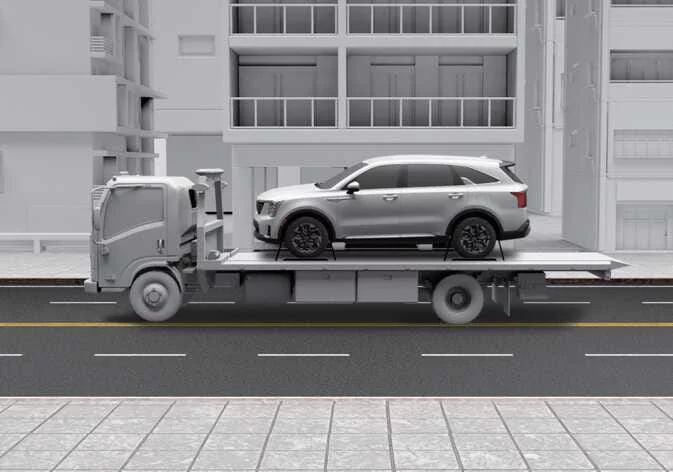
An AWD vehicle cannot be towed safely by an ordinary tow truck using standard methods. If your vehicle must be towed, make sure a professional flatbed truck is used to prevent drivetrain damage.
WARNING
AWD driving
-
Avoid high speeds when turning your Kia Sorento.
-
Do not make quick steering wheel movements (such as sharp lane changes or fast, sharp turns).
-
The risk of a rollover greatly increases if you lose control of your vehicle at highway speeds.
-
In a collision, an unbelted person is significantly more likely to die than a person wearing a seat belt.
-
Loss of control often occurs when 2 or more wheels leave the road and the driver overcorrects to reenter the road. If your vehicle leaves the road, do not steer sharply. Instead, slow down before you reenter the road.
NOTE
Mud or snow
If a front or rear wheel begins to spin freely in thick mud or deep snow, you can sometimes drive your Kia Sorento out by smoothly applying more pressure to the accelerator pedal. However, avoid continuously revving the engine at an excessively high RPM, which could overheat and damage your vehicle’s AWD system.
-
Driving in sand or mud
-
Maintain a slow, constant speed and engage the accelerator pedal gradually to ensure safe driving and prevent your Kia Sorento wheels from slipping on loose surfaces.
-
Maintain a safe and sufficient following distance from any vehicle traveling ahead of you.
-
Reduce your driving speed and constantly monitor changing road conditions.
-
To prevent getting stuck in difficult terrain, avoid excessive speeding, rapid acceleration, sudden braking, and sharp steering turns.
-
Your vehicle’s wheels may temporarily limit operation when stuck in deep snow, sand, or mud. This protective function is designed to safeguard the transmission and is completely normal.
NOTE
Forcibly moving your vehicle to get it out of mud or sand can cause:
-
Severe mechanical damage to your vehicle
-
Premature damage to your tires
-
The engine to overheat
-
Damage to or complete breakdown of your transmission, differential, or AWD systems
If the wheels slip excessively after you enter a sandy or muddy road, your Kia Sorento may settle deeper into the terrain. In this scenario, place a flat stone or tree branch under the affected tire, then try to pull out the vehicle or get it unstuck by repeatedly moving gently back and forth.
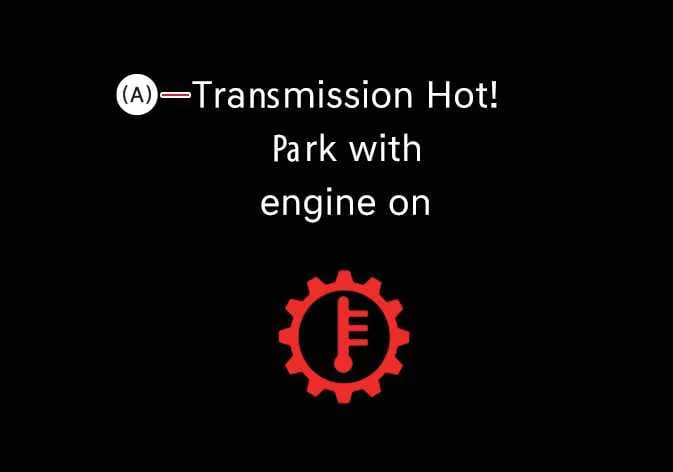
Transmission overheated
|
(A) Transmission Hot! Park with engine on |
|
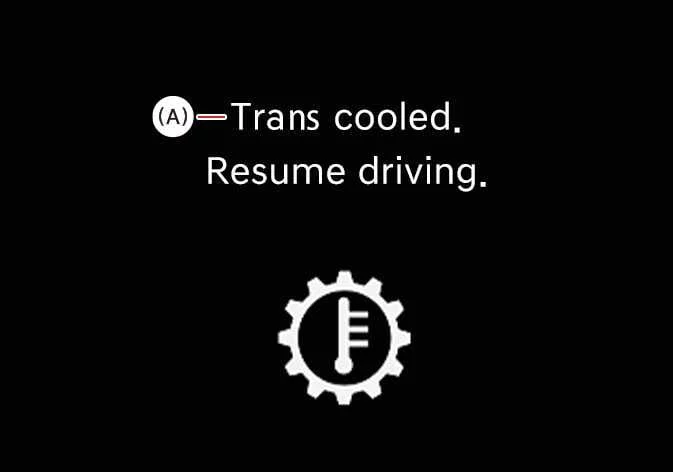
(A) Trans cooled. Resume driving. |
-
The transmission can overheat when you drive continuously on extremely muddy or sandy roads.
-
When the transmission overheats, a safety protection mode activates, the “Transmission Hot! Park with engine on” warning message appears on the instrument cluster, and an audible chime sounds.
-
Pull over to a secure location, stop your vehicle with the engine running, engage the brake pedal firmly, shift the gear selector to P (Park), and allow the transmission to cool down properly.
-
Driving conditions will worsen if you ignore this warning. You may experience abrupt gear shifts, frequent shifting, and vehicle jerkiness. To return to normal operating conditions, park your vehicle and allow the transmission to cool for a few minutes with the engine ON before resuming your trip.
-
You can safely continue to drive your Kia Sorento once the message “Trans cooled. Resume driving” appears on your screen.
If any of the warning messages on the instrument cluster continue to blink or persist, have the system inspected immediately by an authorized Kia dealer.
Tire precautions
Always pay close attention to the condition of the tires on your AWD vehicle.
Because AWD applies driving force to all 4 wheels, tire condition directly impacts your driving performance and safety:
-
When replacing tires, be sure all 4 tires match in size, type, tread design, brand, and load-carrying capacity. Do not equip your Kia Sorento with mismatched tires, as this compromises vehicle stability and could lead to steering failure or rollover, resulting in serious injury.
-
Rotate the front and rear tire positions every 6,000 miles (10,000 km) to ensure even wear.
-
During cold weather, check each tire monthly and maintain the inflation pressure recommended on your vehicle placard or door pillar label.
-
Install snow chains on all 4 tires of your AWD vehicle if required, and keep your travel distance as short as possible to prevent mechanical damage to the AWD system. For more information, refer to the tire chains section.
Towing precautions
|
|
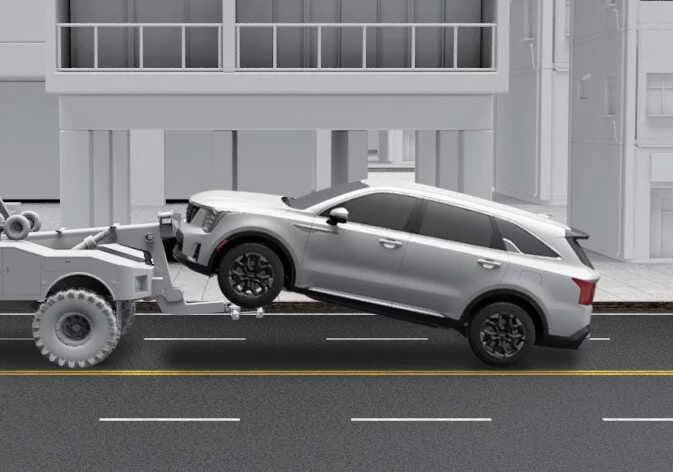
An AWD Kia Sorento vehicle should never be towed with any of its wheels touching the ground. Your vehicle must be transported using a wheel lift with dollies or flatbed equipment so that all wheels are completely off the ground.
For more information, refer to the Towing section.
TIP
An AWD vehicle cannot be towed safely using sling-type equipment. Always use a wheel lift or flatbed equipment.
WARNING
Your Kia Sorento is equipped with tires engineered to maximize handling safety. Do not use tires or wheels that differ in size and type from original equipment specifications, as this can severely affect performance and lead to steering failure or a rollover. When replacing tires, ensure all 4 components match in size, type, tread, brand, and load capacity.
CAUTION
Jacked vehicle
While your Kia Sorento is being raised on a jack, never start the engine or allow the tires to rotate. If rotating tires touch the ground, your vehicle could shift off the jack and lunge forward.
-
AWD vehicles must be tested using a specialized 4-wheel chassis dynamometer.
TIP
Never apply the parking brake while performing these specialized tests.
-
An AWD vehicle should not be tested using a standard FWD roll tester. If a FWD roll tester must be used for testing, follow these precise steps:
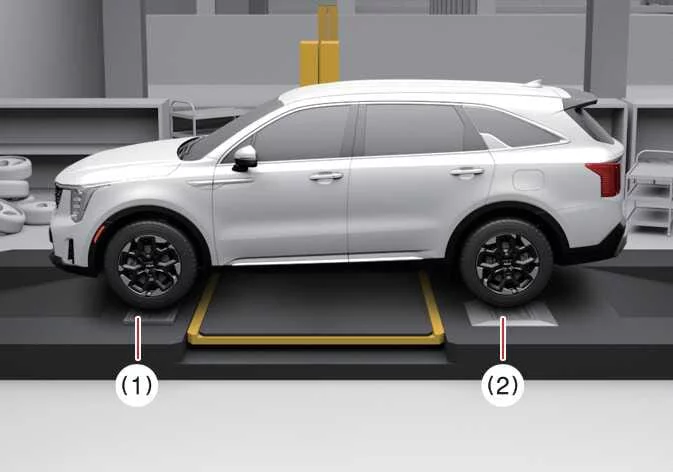
-
Roll tester
-
Temporary free roller
-
-
Check the recommended tire pressure values specified for your vehicle.
-
Place the driven wheels securely on the roll tester (1) to conduct a speedometer test.
-
Completely release the parking brake.
-
Place the non-driven wheels on the temporary free roller (2).
WARNING
Dynamometer testing
Stay clear of the front of your Kia Sorento while it is in gear on the dynamometer test bench, as the vehicle can suddenly jump forward and cause serious injury or death.
TIP
-
When lifting the vehicle, do not operate the front and rear wheels independently; you should operate all 4 wheels together.
-
If operating the front and rear wheels while the vehicle is lifted is necessary, ensure the parking brake is fully released.
 AWD. Switching from/to Terrain Mode: (if equipped)
 Brake system
See also:
Power Tailgate Unit Removal
1.
Disconnect the negative (-) battery terminal.
2.
Remove the rear left luggage side trim.
(Refer to Body - "Interior Trim")
...
Specifications
Direct control VFS[LINE Pressure]
▷ Control type : Normal high type
Control Pressure kpa
(kgf/cm², psi)
539.370 ~ 0 ( 5.5 ~ 0, 78.23 ~ 0)
Current va ...
Power Seat Motor Inspection
Power Seat Motor
1.
Disconnect the connectors for each motor.
(Refer to Body - "Front seat")
2.
With the b ...
Manuals list
- Kia Sorento MQ4 2021-2026 Owners Manual
- Kia Sorento XM 2011-2015 Owners Manual
- Kia Sorento XM 2011-2015 Service Manual
