
 Kia Sorento: Instrument panel overview. Engine compartment overview
Instrument panel overview
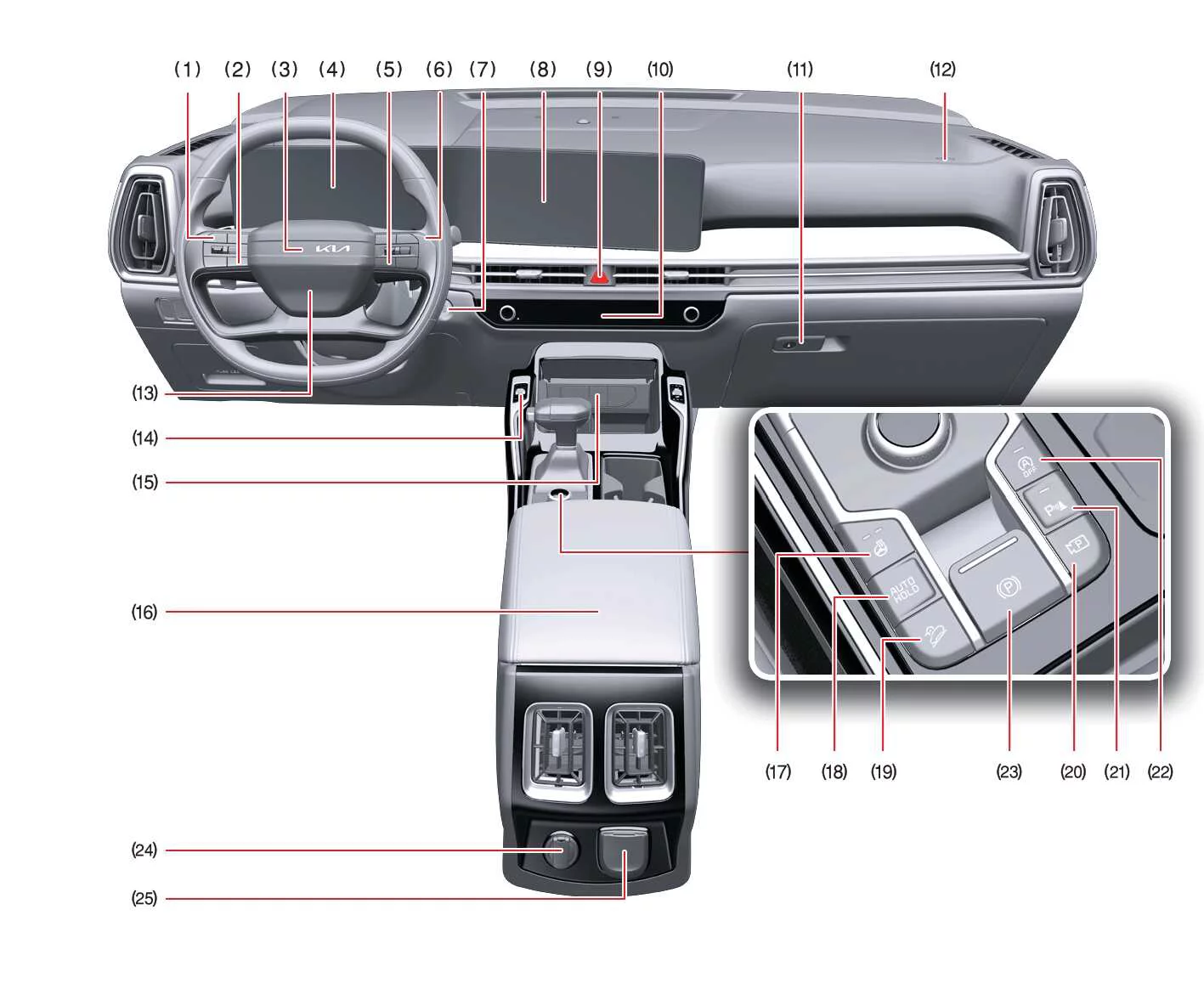
The layout of instrument panel features in your Kia Sorento may exhibit slight visual differences based on equipment specifications, country variants, or selected infotainment options.
-
Light control/turn signals lever - Lighting: Operates headlight modes, automatic high beams, fog lights, and directional turn signals effortlessly.
-
Audio remote control button: Provides intuitive tactile control over volume levels, media source switching, voice commands, and track selection directly from the steering wheel.
-
Driver’s front air bag - Driver’s and passenger’s front air bag: Integrated cleanly within the steering wheel hub to provide high-level supplemental occupant protection during front collisions.
-
Instrument cluster - Instrument cluster: Displays high-definition digital gauges, real-time trip information, vehicle diagnostics, and critical safety notifications directly in the driver line of sight.
-
Driving Assist button - Lane Keeping Assist (LKA), Smart Cruise Control (SCC): Engages advanced semi-autonomous safety systems, including automated lane centring and distance-pacing cruise control.
-
Wiper and washer control lever - Wipers and washers: Controls front and rear windshield wiping speeds, rain-sensing automatic modes, and washer fluid spray functions.
-
ENGINE START/STOP button - ENGINE START/STOP Button: Enables keyless push-button ignition activation and engine shutdown when paired with a valid smart key.
-
Infotainment system - Infotainment system: Serves as the high-resolution central hub for satellite navigation, smartphone connectivity, multimedia features, and vehicle setting customization.
-
Hazard warning flasher switch - Hazard lights switch: Instantly activates all exterior turn indicators simultaneously to warn surrounding traffic of emergency stops or hazardous situations.
-
Climate control system - Automatic climate control system: Maintains preferred cabin temperatures automatically with multi-zone heating, cooling, and air filtration controls.
-
Glove box - Glove box: Offers a secure, illuminated storage compartment for vehicle manuals, essential documentation, and personal items.
-
Passenger’s front air bag - Driver’s and passenger’s front air bag: Houses a specialized passenger restraint system designed to deploy safely from the dashboard in severe frontal impacts.
-
Horn - Horn: Emits an audible warning signal via central steering wheel pressure to alert other road users in emergency situations.
-
Front seat warmer and air ventilation seat button - Seat warmer, Air ventilation seat: Regulates multi-stage seat cushion heating and cooling ventilation for superior front-passenger climate comfort.
-
Wireless charging system/USB Charger - Wireless smartphone charging system, USB charger: Combines an inductive phone charging pad with high-speed USB power ports to keep mobile devices powered on every journey.
-
Center console storage box - Storage compartments: Features a spacious, padded armrest compartment designed to organize larger personal items and daily essentials.
-
Steering wheel heater button - Steering wheel heater: Heats the leather steering wheel rim quickly to deliver enhanced comfort during cold weather driving conditions.
-
AUTO HOLD button - Auto Hold: Automatically maintains braking pressure after coming to a full stop, relieving pedal effort until the accelerator is pressed again.
-
DBC switch - Downhill Brake Control (DBC): Maintains controlled, slow vehicle speeds on steep off-road descents without requiring continuous brake pedal input.
-
ISG OFF button - Idle Stop and Go (ISG) system: Allows driver deactivation of the automatic engine stop-start system to keep the engine idling continuously when desired.
-
Parking Safety button - Parking Safety button: Activates or mutes ultrasonic parking sensors and active collision avoidance warnings during low-speed maneuvering.
-
Parking/View button - Parking/View button: Toggles surround-view camera feeds and parking monitor visuals manually on the central infotainment display.
-
EPB switch - Electronic Parking Brake (EPB): Replaces traditional handbrakes with an effortless push-button electronic parking brake featuring automatic disengagement.
-
Power outlet - Power outlet: Supplies reliable 12V auxiliary DC power to run portable automotive accessories and electronic equipment.
-
AC Inverter - A/C inverter: Converts vehicle battery power into household alternating current (AC) to run standard household electronics directly inside the cabin.
Engine compartment overview
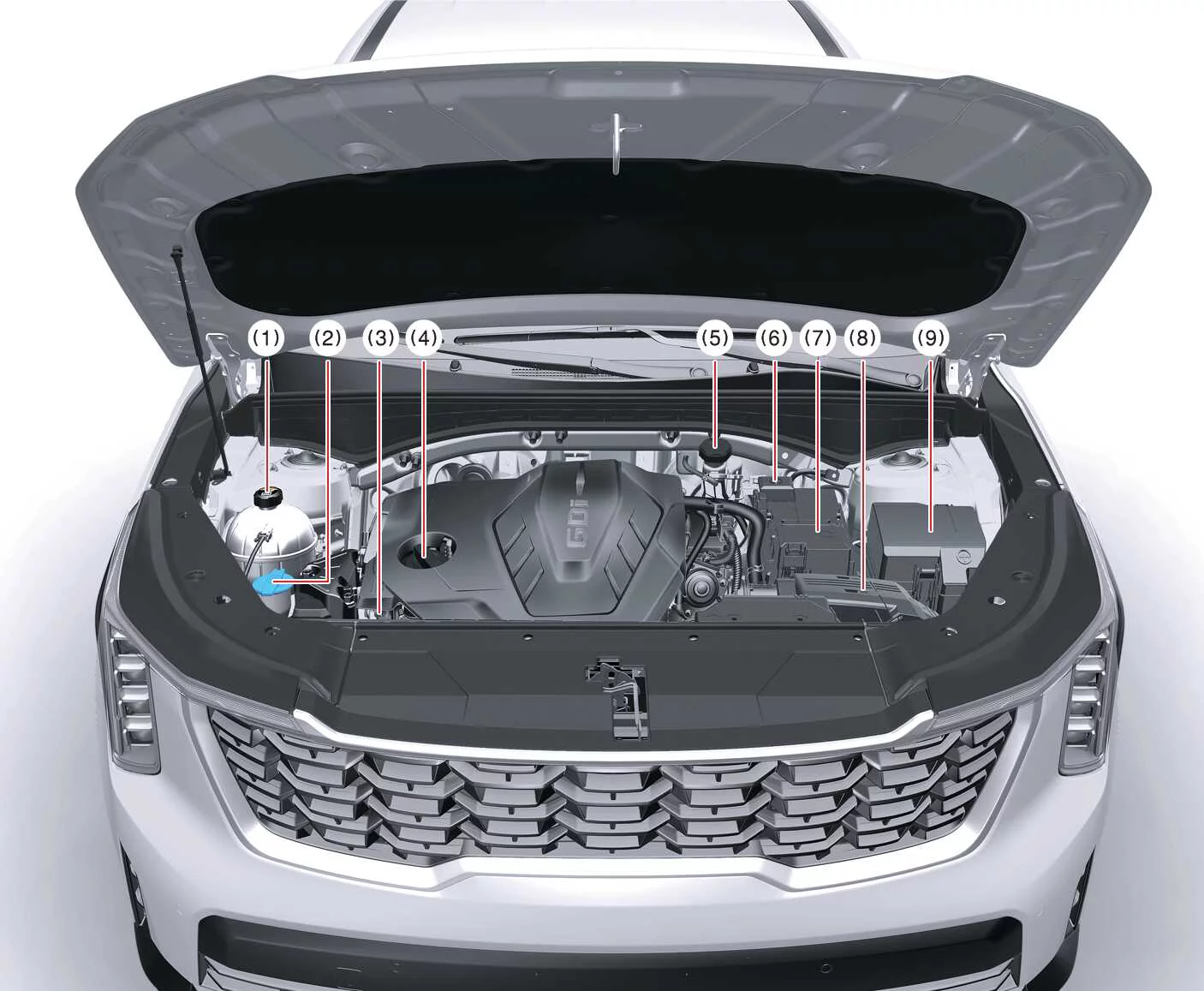
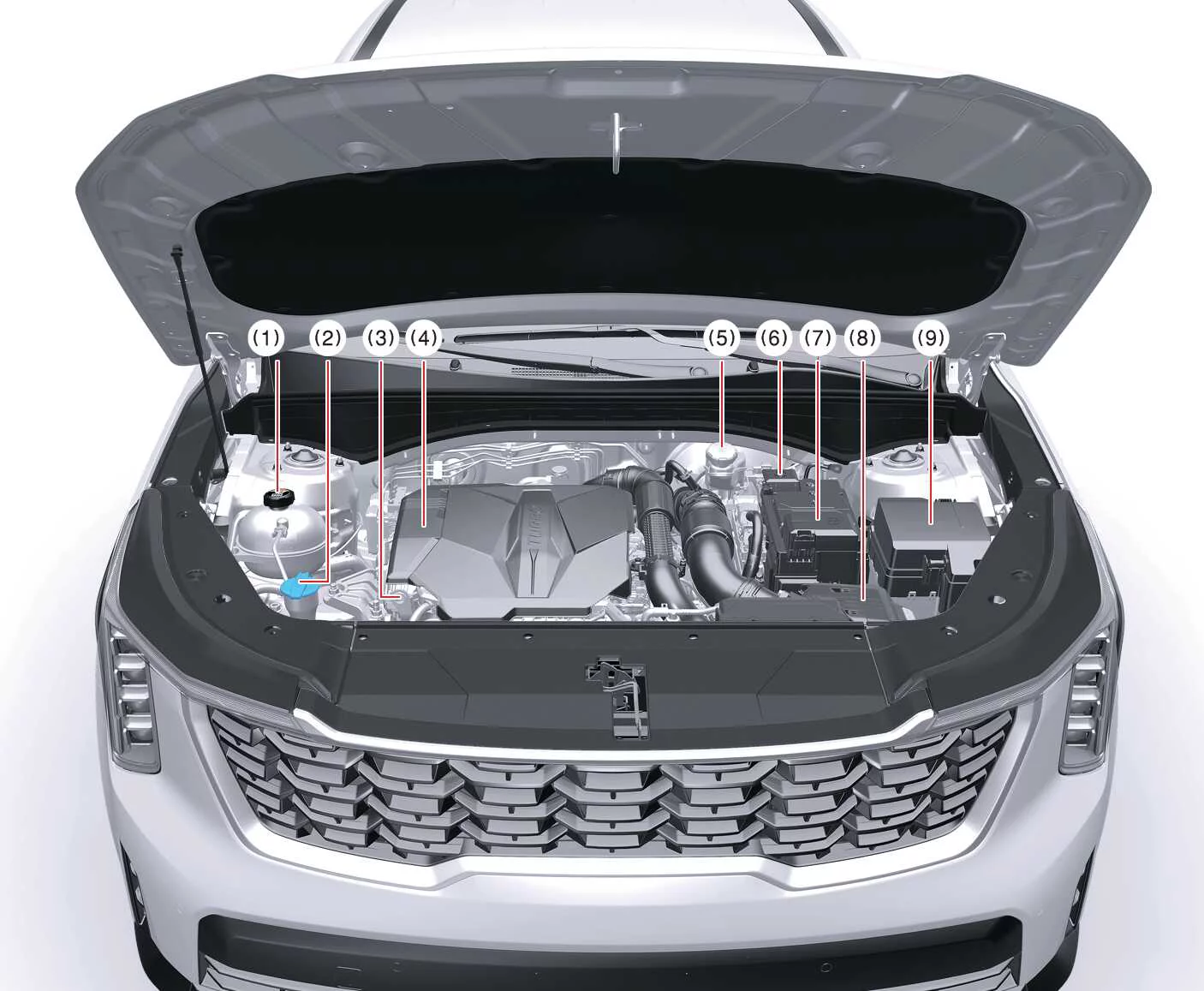
The precise arrangement of components, covers, and fluid reservoirs inside your Kia Sorento engine compartment may vary depending on the chosen engine variant and vehicle equipment package.
-
Engine coolant reservoir - Engine coolant: Translucent expansion tank allowing visual checking and replenishment of cooling system fluid levels to prevent engine overheating.
-
Windshield washer fluid reservoir - Washer fluid: Easy-access fluid tank fitted with a level indicator cap to ensure continuous windshield cleaning performance.
-
Engine oil dipstick - Engine oil: Manual measuring gauge designed to check engine oil capacity and fluid condition quickly during routine maintenance.
-
Engine oil filler cap - Engine oil: Securely sealed port designed for adding recommended synthetic engine oil during service routines.
-
Brake fluid reservoir - Brake fluid: Protected hydraulic fluid container providing visual verification of brake system fluid integrity.
-
Positive battery terminal - Jump starting, Battery: Covered high-current electrical point designated for auxiliary cable connection during jump-starting procedures.
-
Negative battery terminal - Jump starting, Battery: Secure chassis ground point used for safe battery cable attachment during emergency jump starts.
-
Air cleaner - Air cleaner: Protective air filter housing housing dry filter elements that protect engine combustion chambers from airborne dust and particles.
-
Fuse box - Engine compartment fuse panel: Primary under-hood electrical distribution box housing high-amperage fuses and control relays for powertrain systems.
 Exterior Overview. Interior overview
 Specifications
See also:
Air Ventilation Seat Installation
1.
Install the blower fan.
2.
Install the seat back and cushion.
...
Output Speed Sensor Installation
1.
Install in the reverse order of removal.
...
Tightening Torques
Item
N.m
kgf.m
lb-ft
Ignition coil installation bolt
9.8 ~ 11.8
1.0 ~ 1.2
7.2 ~ 8.7
Spark plug installation
14.7 ~ 24. ...
Manuals list
- Kia Sorento MQ4 2021-2026 Owners Manual
- Kia Sorento XM 2011-2015 Owners Manual
- Kia Sorento XM 2011-2015 Service Manual
