
 Kia Sorento: ESC Control Module Removal
Second Generation XM (2011-2026) / Kia Sorento XM 2011-2026 Service Manual / Brake System / ESC(Electronic Stability Control) System / ESC Control Module Removal
| 1. |
Turn the ignition switch OFF.
|
| 2. |
Remove the surge tank. [G3.3 GDI]
(Refer to Engine Mechanical System - "Surge Tank")
|
| 3. |
Remove the brake fluid from the master cylinder reservoir with
a syringe.
|

| 4. |
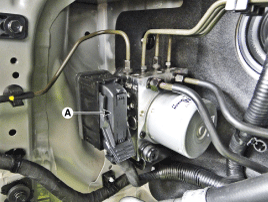
Pull up the lock of the HECU connector (A) and then disconnect
the connector.
|
| 5. |
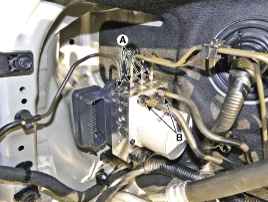
Disconnect the brake tubes from the HECU by unlocking the nuts
counterclockwise with a spanner.
|
| 6. |
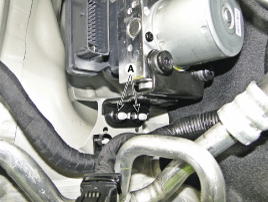
Loosen the HECU bracket nuts (A) and then remove HECU and bracket.
|
| 7. |
Remove the bolts and then remove the bracket from HECU.
|
 ESC Control Module Components
1. Front - left tube
2. Rear - right tube
3. Rear - left tube
4. Front - right tube
5. MC2
6. MC1
7. ESC control module (HECU)
8. Bracket
...
 ESC Control Module Installation
1.
Installation is the reverse of removal.
2.
Tighten the HECU mounting bolts and nuts to the specified torque.
3.
...
See also:
Antenna Coil Installation
1.
Install the coil antenna and connect the 6P connector.
2.
Install the steering column upper and lower shrouds.
...
Parking Brake Pedal Assembly Installation
1.
Install the holding clip (A, B) after fixing the parking brake
cable.
2.
Install the parking brake pedal, and then install the p ...
Front wheel alignment
When using a commercially available computerized wheel alignment
equipment to inspect the front wheel alignment, always ...
Categories
- Home
- First Generation
- Second Generation
- Kia Sorento XM 2011-2026 Owners Manual
- Kia Sorento XM 2011-2026 Service Manual

Copyright © www.ksmanual.com 2014-2026